Fichigan

Small Stream Trout fishing in Michigan

Volkswagens for Camping

It’s a guy thing. Moving from vehicle to vehicle as a statement. Jake, like Feral, gravitates to unusual vehicles. I doubt he’ll ever drive a Ford. I never know what he’ll show up with at trout camp but I am often inspired to take a photo. For a while he was on a VW mode and that was entertaining.
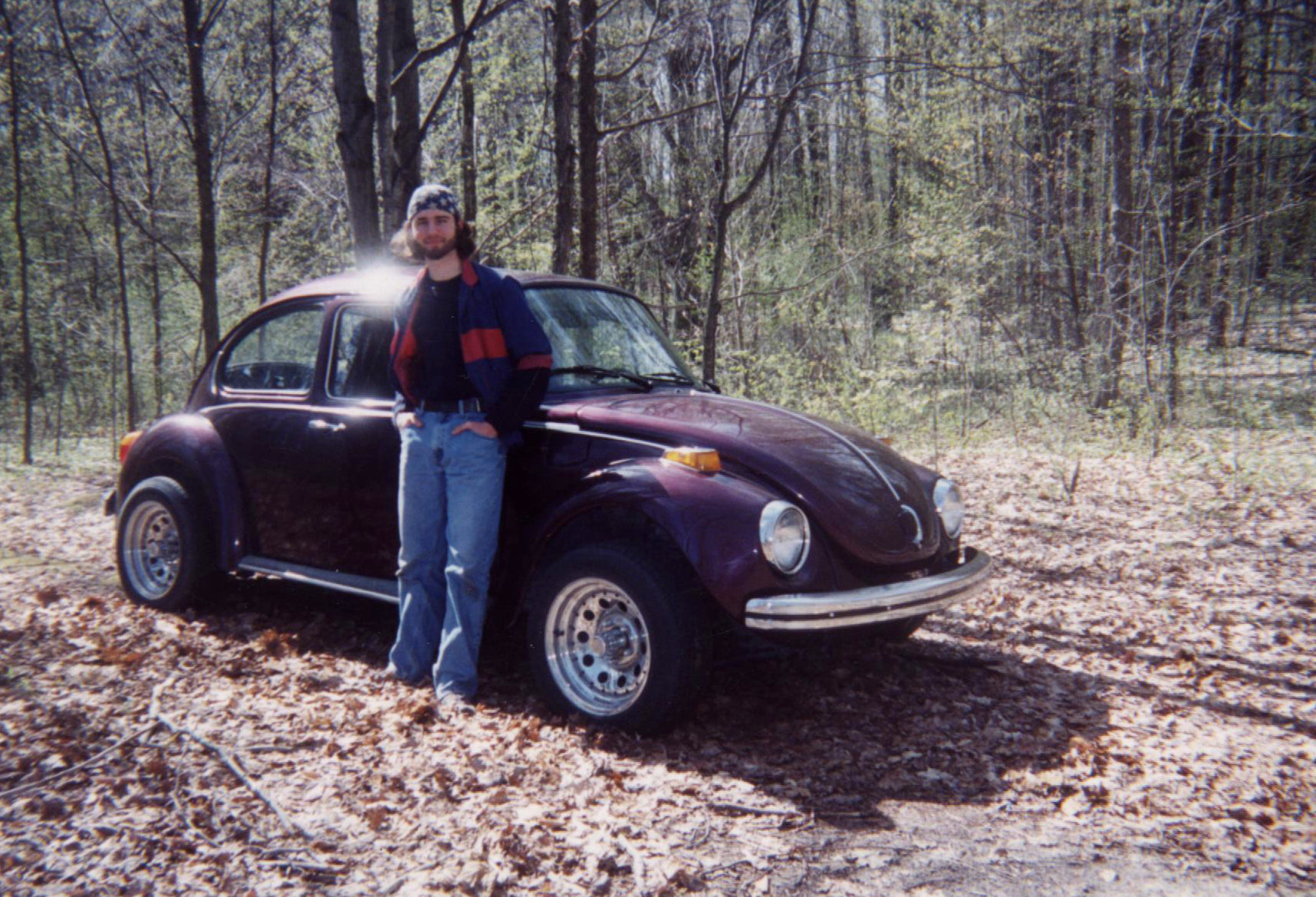
The bug was cool though I seem to recall packing a guitar and camping and fishing gear was an exercise in physics or at least bending atoms. We insist on a guitar since he does some very interesting finger picking including some Chet Atkins. He also plays bass and one time he showed up with a stand-up bass packed into the rear end of a GEO tracker. Another exercise in physics.
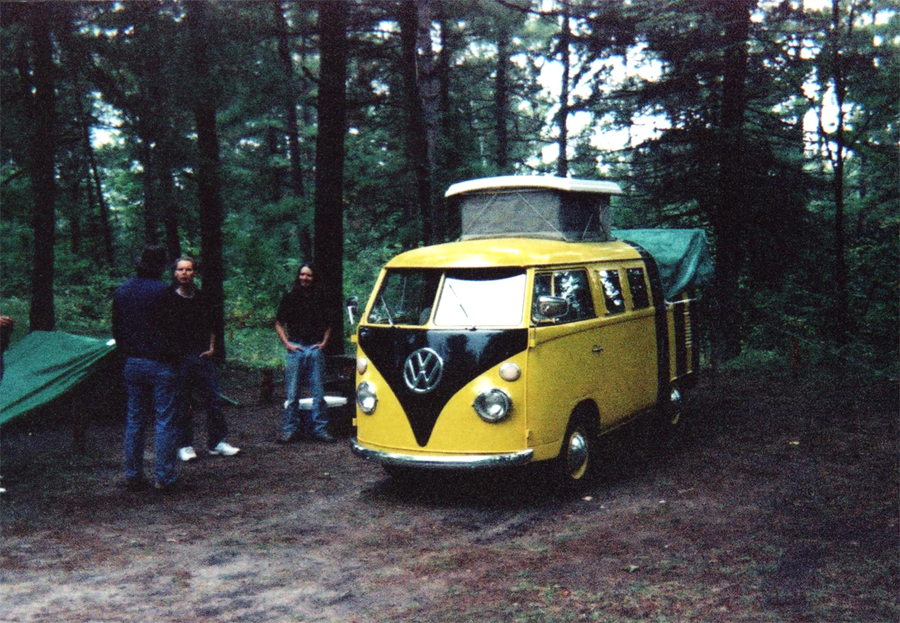
Jake pulled into fall trout camp with the above VW camper van several years ago and that drew a crowd. I believe the pop top allowed a person to stand up inside though you couldn’t walk very far.  Also, there were some clever mechanics that positioned a cot near the ceiling. I wish I would have taken more pictures because it really was a classic. He sold that and that seems to be the way with him and Feral. Life is too short to keep driving the same thing for very long.

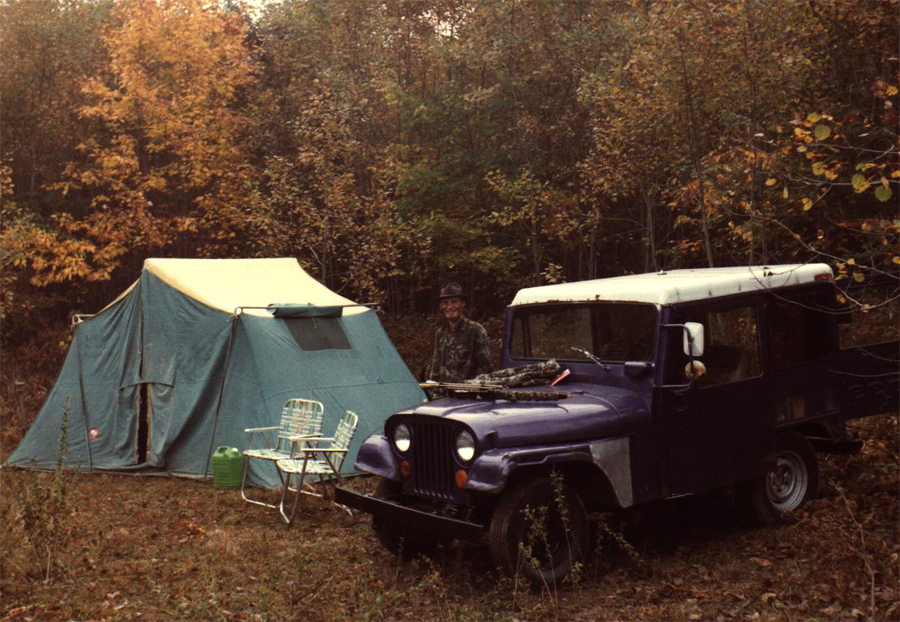
This year Jake showed up with a new Jeep which is a little surprising because Feral, his dad, has a history with Jeeps and many Jeep repair stories. Below is a photo of Feral back in the seventies ready for bow hunting, something we keep talking about because in Michigan the second that trout season ends – bow hunting begins. So that would be an excuse not to break camp and head home. I’m not interested in harvesting a deer, but the woods are spectacular in October.
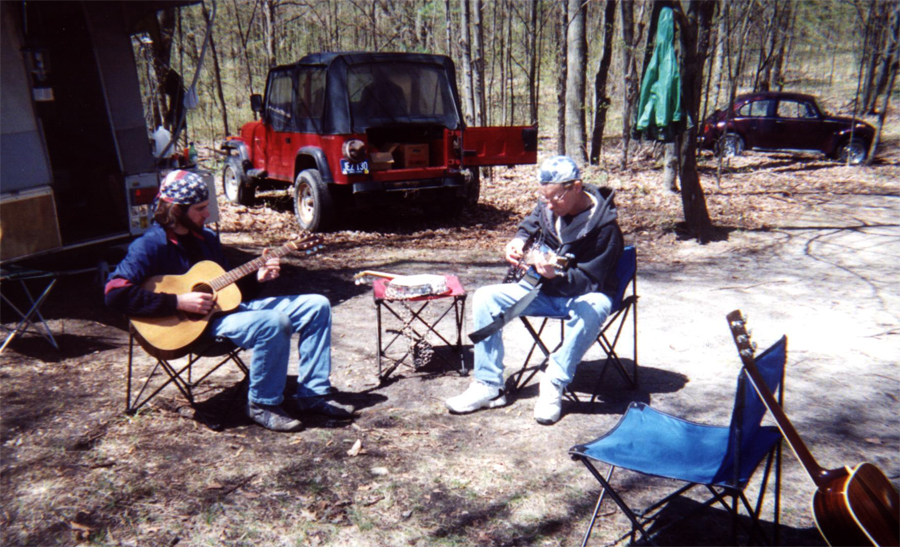
Here is another Feral Jeep with some guitar jamming in the foreground. Feral had good luck with this Jeep and drove it for a while – at least a year and maybe longer. Jake is finger picking a classical guitar, Feral is playing a Dobro, and that’s a 1970 Martin D-35 in the foreground which I sold. Guitars are like cars: Life is too short to keep playing the same one your whole life. Going back to Jeeps, check out the one Natch brought to trout camp a couple years ago on the post about Pickerel Lake. Natch drove us down a treacherous trail to the  to the Sturgeon River that still makes me smile. Deep ruts and odd angles. Jeeps are good for that – going where no man has gone before. Something Feral did with the Dobro.
Big Leverentz Lake

Heading west on 10 out of Baldwin I asked Feral to keep an eye out for any sign of the Baldwin River since we would be driving directly over it – but alas, there was no sign of the river. Michigan has been in a drought for most of the summer and after this weekend I can report something new about this phenomenon. We camped at Big Leverentz and it started raining while we were out on the lake (fishing for bass and pike). It rained for a good half hour. We could see the rain dapple the lake and we could feel a cooling of the atmosphere.  There was a thick overcast blocking out the sun completely (a huge relief since we had been baking in the sun). Here’s where it gets interesting.  We didn’t get wet. After half hour our clothes were still dry. When we pulled the boat back in for the evening – the camp was dry. It occurs to me this might make a good Twilight Zone episode.  For added drama substitute desperate farmers for fishermen.

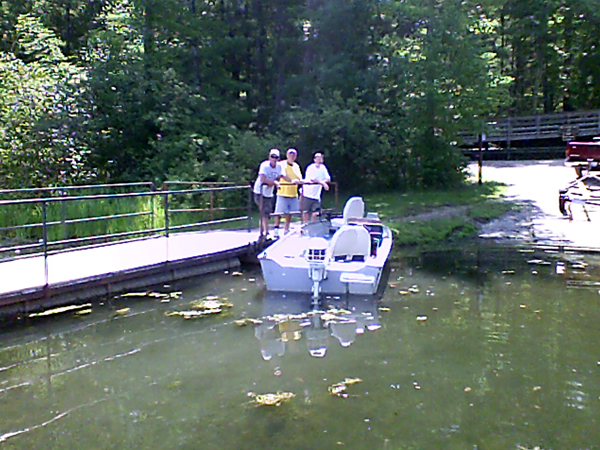
As usual the folks we met camping and fishing were friendly and three guys who waited patiently for Feral and I to launch the boat were treated to a comedy of boat launch errors and may they live by the adage that what happens in Baldwin stays in Baldwin. They were out for panfish and we understand they had around ten though I didn’t get a picture, except for a group photo as proof that they were at the lake.  I apologize for the quality of the picture since it is so fuzzy it could be just about any three guys. If called to testify I’ll vouch they were at the lake if they vouch for my seaworthiness.

In spite of the intense heat and murky lake with strange gunk floating about we did pretty good on the bass and caught one decent pike. Feral tossed a weedless mouse on the pads and had some action but mostly we fished power worms, culprits, and some top water baits late in the evening. Total bass for 2 days around 20 with a few three pounders. For those who know how hard that lake gets fished – I suspect we did alright. The bad news of course is we don’t eat bass. If we get a real rain maybe I can post something for trout fishermen and eat the proceeds.

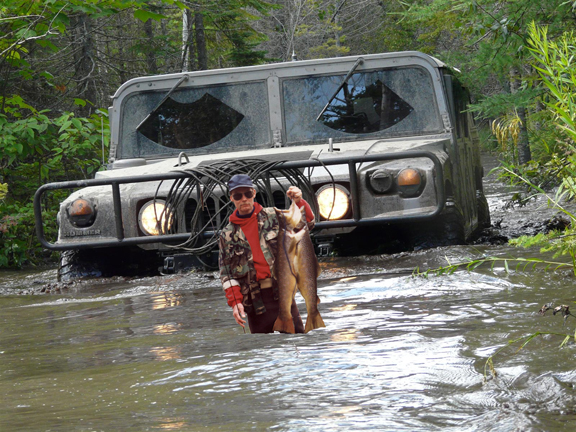
These Fish were not Photoshopped

This nice brace of trout was caught by Feral some time before the turn of the century.  If I recall the story correctly he passed a couple worm fishermen walking the bank upstream, caught the trout in ten minutes, and walked back past them heading downstream. The worm fishermen couldn’t believe their eyes.  A proud moment.  They were kind enough to take this photo and I have been trying to figure out ever since where exactly on the Pine River he caught them.  If you look closely something doesn’t seem right.  Feral assures me the trout have not been photoshopped, but concedes everything else might have been.

Original photo!

Fixing a Fishfinder Transducer

I know I keep veering away from trout fishing and promise to get back to it soon – but this may be important to a fisherman somewhere. I have an older model Humminbird fishfinder, a Wide Eye, from the eighties. The wires to the transducer were sheared (or pulled off) right at the transducer puck. I did some research online and found a replacement for $77.16 at Amazon, but, based on an email to Humminbird Service, I couldn’t be sure the replacement transducer works with my older model. (Service said my unit is so old there are no replacement parts and I should buy a new fishfinder – uuhhh… thanks for the advice?)

I trolled the web to see if there was a way to fix it. The word on the web is: buy a new one because you can’t repair them. I could see their point, in my case the wires I needed to reconnect are encased in the plastic compound of the puck, sort of like Hans Solo encased in Carbonite, but less to work with.

I decided to do surgery on the puck. (What did I have to lose?) The main issue was getting to the wires inside. I took a 1/8th  inch drill bit and made small holes all the way around the spot where the wires exit. I drilled just deep enough to break though the molded plastic seal. Then I chipped away the plastic until I could see the two wires, one black and one red (matching the wires encased in the cable). The wires are tiny – so extreme care has to be taken to work them free of the plastic seal. Once they were free I was able to strip the coating off the two wires using an exacto knife and a lot of patience.

Then I did the same thing with the cable end – stripped and exposed enough of the wires so I could hold and solder them to the wires in the puck. I used a pencil type soldering iron with a fine point. Once the wires were soldered I filled in the hole and soldered joints with two part epoxy. I gobbed on enough so that it covers the cable where it exits the puck. Hopefully it’s as strong as carbonite so the wires don’t pull out again.

The Test: I took the boat out on a local lake and it seems to be working better than ever. It zeroed right in on the bottom. If you are on a budget – don’t trash the transducer. Dig out and solder together the broken off wires and gob up the hole and wires with epoxy. Save yourself eighty plus dollars with very little effort.

Bass Lures for Trout

Trout have a reputation for being finicky and I can probably thank fly fishermen for that. Most published accounts focus on finding the one pattern that works for a particular time and place and that makes me smile since I have pulled junk out of my congested lure tote that resembles nothing a trout has ever seen and proceeded to catch trout.  One time on the lower Baldwin, in a good rain, I lost a favorite lure and had to try something untested. By chance I had a big-lipped deep diving crankbait with me and since the water was high and rising, I figured what the heck. My second cast brought in a medium size brown around 14 or 15 inches. The Big “O” type lure was mostly green and had a fish type pattern that was supposed to resemble a bluegill. Not much chance the trout I caught had ever seen a bluegill. I caught one or two more keepers on the lure before finally calling it a day.

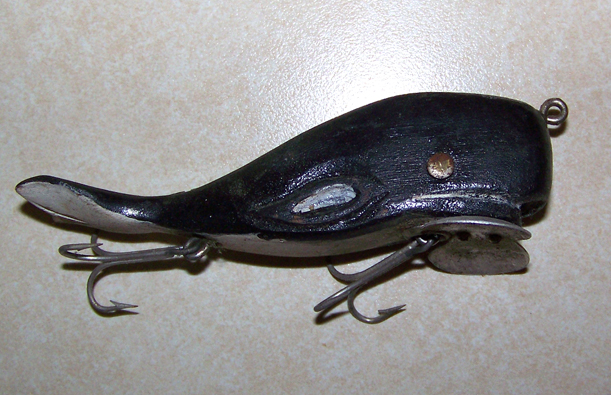
I haven’t caught a trout yet on the #3 Sperm Whale pictured above but I don’t count it out. My reading is it’s a night lure and I know just the pool to try it on. It’s designed to wobble like a jitterbug and who knows what kind of leviathan it might call up from the deep. I’m half afraid to use it since it may be the only one like it in existence and I don’t have to tell you what the antique lure market is like.

One year Natch, our “wired” fishing buddy, hit the bargain bin at Wal-Mart on the way up to trout camp. He picked up some dollar bass lures of various strange patterns. He caught trout and what really amazes me is that for several years running he took “big fish” honors in our annual contest. I can’t say it was the dollar bass lures, we keep some secrets, but I know he experiments.

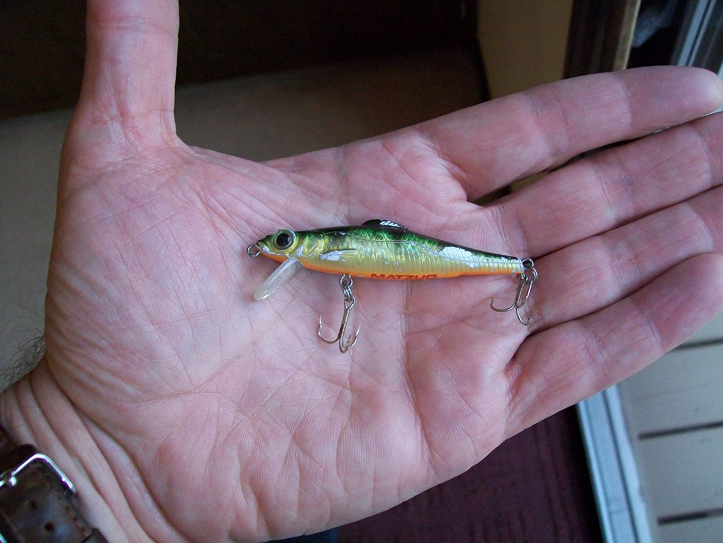
I recall another year when we trout camp regulars were disgusted by the rising price of our “standard trout lures” and experimented with new lures by Japanese companies. The Japanese get creative and have made a huge impact on the professional BASS tour. Some lures are reminiscent of their monster movies although this one reminds me of the Nautilus from 2000 Leagues under the Sea.

As you can see the lure has a perch pattern and I’m pretty sure the stream trout I fish for have never seen a perch.  Or the Nautilus. Feral and I ran into this lure by accident. He had invited a buddy from Alpena to go fishing and we stopped so the guy could buy a couple lures. He wasn’t a trout fisherman and chose this to our dismay. Once on the stream we watched him pull in trout after trout while we shook our heads and tossed old standards without luck. So there’s a good clue. Trout aren’t afraid to change their diet. Generally speaking – they are after an easy meal.

Saving Silver Lake

Silver Lake, up by Hart Michigan, is unique for its beauty and recreation. Sand dunes abut the lake on the west shore, the same sand dunes that are famous for the dune rides. There is a state park with camping and it must be one of the most popular parks in Michigan because any time I have driven by the park it appears full up.  The lake has great bass, walleye, and pike fishing and is a treasure for Michigan, not just the lucky homeowners, but for campers and visitors.

Last summer a strange thing happened. Over 3000 carp died off and washed up on the shores. Most folks (at least me) didn’t realize there were carp in the lake. Perplexed homeowners had to clean up the shoreline. According to the DNR, the fish die off was caused by koi herpesvirus, or KHV virus, specific to koi, carp and goldfish, however the source of the virus is unknown. It may have been introduced by released ornamental fish and illustrates the danger of releasing exotic fish in waterways.

The carp die-off caught the attention of a new lakefront homeowner and activist, Dr. William DeJong, my brother-in-law. Bill is one of those very high energy people that solve problems while others sleep and as a new homeowner he decided to research the lake further. Bill uncovered reports by Progressive Engineering classifying Silver Lake as meso-eutrophic which indicates high phosphorous levels. High phosphorous can lead to excessive weed growth (already noticed by homeowners), increased algae, and ultimately affect what fish species can survive in the lake. The source of phosphorous is a very complex problem but sewage is a contributing factor. The cottages all have septic systems. There is a well developed smaller lake upstream of Silver Lake and that too is all septic. There is a watershed feeding the little lake.

As Bill explains it, the problem may come from a dozen possible sources or combinations of sources, so until there is a clear understanding of the problem, expensive sewer systems or upstream holding ponds should be avoided. What’s needed is a comprehensive diagnostic evaluation to identify the phosphorous source and spell out options. This is more costly than a piecemeal approach and requires the cooperation of the lake property owners, local and state governments. Proper evaluation now could save million of dollars later and ensure the health of Silver Lake. Bill is the right person to try to get consensus and funding to solve this complex problem and the homeowners and the state need to support his efforts.

A little bit of Bio on Bill DeJong: He is a semi-retired educational facilities consultant that pioneered studies to rebuild and update schools systems throughout the U.S. Bill also started a charity called Schools for Children of the World that literally builds schools in third world countries. He visits poverty stricken areas, develops education plans, and pitches in with the actual construction. I am adding a link for anyone that would like to contribute or volunteer on a school building project.  www.SchoolsForChildren.org

Small Tents and Good Sense

I’ve had a variety of large and small tents including my 61 Apache Chief Tent Camper, which is more of a tent on wheels than a camper. For regular tents I started off big – big enough to stand up in and plenty of floor space so I could move my sleeping bag to the middle in a good storm to avoid the puddles and lakes that would form in the low ground wherever that was. Placement of the tent, especially big “family” size tents is critical since there is not a level spot in all the woods or campgrounds in Michigan. Preparing for rain is an integral part of camping and this usually involves the tent, a plastic tarp, and a shovel. The tarp is self explanatory. The shovel is used to create a trench around the tent designed to carry the rainwater anywhere that is not under the tent.  It never actually works but it gives the camper something else to do that seems important and manlike.

I like big tents but I have never seen one that doesn’t take an engineering degree and three people to set up.  And a one-ton press to flatten it sufficiently to put back in the carrying case. They offer pretty good rain protection (with a plastic tarp) and having the big space inside also provides a false sense of security in bear country which is helpful for a good nights sleep.

I misrepresented myself here – I actually started off with a small tent – a pup tent. I think the name came from the fact that small dogs were the intended users. Back a very long time ago, my brothers and I acquired one of these, I don’t know how. It was a basic inverted V of canvas with a center pole running down the middle like a doghouse with no sides. It could fit two small boys or one hound.  I am trying to remember if the thing had a floor, but I suspect not. I do remember that setting it up was a four boy operation since someone had to hold the upright at each end while someone else attached the ropes to the stakes and pounded them in.  It was the fourth boy’s responsibility to direct the operation and be the General.

I am happy to report small tents have made some strides toward common sense and utility. Two years ago I decided to buy one for quick trips and one-nighters (and also if I wanted to pull my boat instead of the tent camper). I knew what to look for because Feral sold his J C Higgens tent camper to Jake and bought a small tent.  It looked easy to set up.  I bought a Eureka Tetragon 2, the same brand / different model as Feral.  I have used it a half dozen times and now I can set it up before Feral has found my cooler and knocked down half a beer. So that’s really fast.

If you want tent buying advice here is the one important tip to take from this post: Look for a shock-corded external pole system where the tent clips to the poles instead of the poles threading through a closed seam channel.  You can see what I mean from the picture. To set up you attach the poles to the corners and hold them together while you clip on the tent – very simple and fast.

The Tetragon 2 is considered a two man tent, and Feral has the four man version. If you divide the number of persons a tent is rated for by two you will get the actual number of people a tent will hold without someone complaining.  I love my two man one man tent. It’s too small for anything but sleeping, but it’s comfortable.  I lay some carpet samples down on the ground and set the tent up over them. The tent has a lot of screen so airflow is good (minimal condensation) and the rain fly works. No tarp required.

A Wasted (fish) Life

Natch with one for the skillet

I hate to release a trout I think won’t survive. In Michigan there are minimum size limits for various trout species and it seems like the aggressive undersize trout are the ones most likely to perish from unhooking and handling. Unfortunately, if you are caught with an undersize trout you could face a fine – maybe even lose your license. So there is the dilemma – let the trout go when you know he may die or take it home to eat and risk a fine.  This may be a case where a little common sense may improve the law – allow a single undersize fish in the creel. Trust the angler to make a judgment call about the condition of the fish.

Larger fish are usually pretty tough. I have caught trout with a patch over one eye and their left pectoral fin tied behind their back, so survival rate is pretty good after they hit about fifteen inches. It is the duty of these experienced fish to teach the young ones about the various lures and how to recognize a treble hook, but I suspect the tough economy has had a trickle down effect so and more and more little trout have to fend for themselves without the sage advice of their elders.  The scary hook jawed trout wearing eye patches may offer advice at the stream corner but if little trout are like little people, their mommas told them not to talk to strangers.

From what I have seen there are no shortage of little trout – at least on the streams I fish. That may have a lot to do with the good management of the resource, or, more likely, on the ability of nature to replenish itself in spite of man.

I fished a steam about fifteen years back that crossed a major highway straddled by farm country. It was small, maybe ten to twelve feet wide with some mix of bottom including gravel and some very sandy stretches.  When I stepped on the sand, bubbles of gas came up that stunk like nothing I can describe. I suspect it had something to do with chemical run off from farm land. I kept fishing and caught a few small trout but sure didn’t keep any. After about an hour I came to a sharp bend and at the head of the bend the water was channeled through a tight spot.  I tossed my lure in the backwater of the tight spot and saw the largest brown trout I’d ever seen on a small stream. He made a wake going for my lure then ducked into the deep hole in the bend. I went back once or twice hoping to see that fish again. I suspect that massive trout had a couple good stories and with the help of chemicals may have spoken proper English but I never got the chance to interview him.

Back to small trout badly hooked, and some clarification: Depending on the stream, I’d like the option to cook up the ones I think won’t make it. If they speak English and ask to be put back I’ll honor their wishes.

The Unspoken Contest

Denny is a trout camp regular and even more important a family friend. Strangely he has been best friends with myself and both of my brothers at different points in our lives. He is a character, with character, and to me the fact that he’s stayed connected says something very nice about our family. There is a quiet strength about him that may be hidden to some people by his outgoing personality and wit, but knowing him has made a difference in our lives. Sounds like a Eulogy in progress, but he’s fine, though he did have a scare and some surgery a short while back.

The photo above was taken a few years ago at fall trout camp. Feral and I had an ongoing, unspoken contest with Mike and Denny regarding the largest trout and we were taken back when Denny pulled this one out of his cooler. We don’t necessarily keep the fish, we use the honor system and keep a tape or de-liar on us when we go out, but Denny happened to keep the one shown here, a two-footer. He caught it on the Sturgeon casting from the bank because the river was too high and muddy to wade. It is difficult to present just how difficult a task it is to pull a fish like that out of the Sturgeon – even in the best stream conditions. To do it from the bank is next to impossible. So there you go, Denny is a trout fisherman and certainly has earned a seat at trout camp, not to mention a spot at the family table.

Fishing Alone

Back in the 80s and 90s I worked for a large company run by human beings that allowed me to take my vacation time in half days so I was able to run up to the Pine River on rainy afternoons. The Pine would come alive under a summer rain and that meant I brought trout home for my growing family including two young daughters that didn’t mind eating fish if I cooked them up to resemble Chicken McNuggets.  The days of large companies run by human beings came to a close and my daughters grew up, but the desire to head off on my own once in a while never went away. It’s true I fish with Feral often because mainly we seem to key into each others sense of humor and you can’t place a value on that. Still, when we camp, we are not averse to cutting off a good stretch by ourselves because that is the way to enjoy trout fishing – it tests your skill, you get to fish the best holes how you think will work best, and for some people, like Feral and myself, being alone is never a problem.

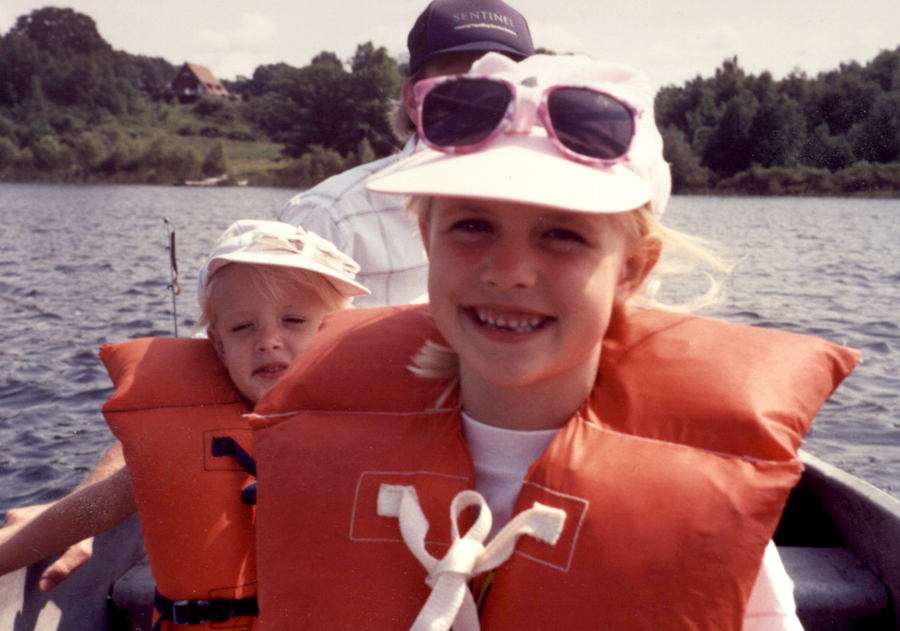
Trout fishing is a solo gig if you want to do it right. It is a chance to enjoy solitude and breathtaking scenery. It is a way to slow down and feel a part of something larger than you. I worry that I did not do right by my daughters by taking them on trout streams. They were just so feminine and girlish, like my wife, and I ran off too often to do my own thing. It’s true we went bluegill fishing on lakes and we had our family vacations, but teaching them to love trout fishing didn’t happen – so there is my regret. I should have shared that with them too.

My beautiful daughters

I am struggling to say what it is I mean about the value of trout fishing alone. It’s not the act of fishing so much as realizing when you are out there that you are truly alone in the world, and the world is an amazing place to be.  Once you have that perspective, you can face life’s challenges.

Post Navigation