Fichigan

Small Stream Trout fishing in Michigan

Archive for the tag “brown trout”

Bass Lures for Trout

Trout have a reputation for being finicky and I can probably thank fly fishermen for that. Most published accounts focus on finding the one pattern that works for a particular time and place and that makes me smile since I have pulled junk out of my congested lure tote that resembles nothing a trout has ever seen and proceeded to catch trout.  One time on the lower Baldwin, in a good rain, I lost a favorite lure and had to try something untested. By chance I had a big-lipped deep diving crankbait with me and since the water was high and rising, I figured what the heck. My second cast brought in a medium size brown around 14 or 15 inches. The Big “O” type lure was mostly green and had a fish type pattern that was supposed to resemble a bluegill. Not much chance the trout I caught had ever seen a bluegill. I caught one or two more keepers on the lure before finally calling it a day.

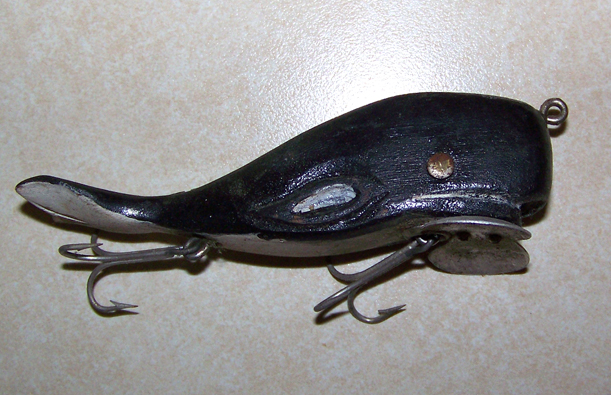
I haven’t caught a trout yet on the #3 Sperm Whale pictured above but I don’t count it out. My reading is it’s a night lure and I know just the pool to try it on. It’s designed to wobble like a jitterbug and who knows what kind of leviathan it might call up from the deep. I’m half afraid to use it since it may be the only one like it in existence and I don’t have to tell you what the antique lure market is like.

One year Natch, our “wired” fishing buddy, hit the bargain bin at Wal-Mart on the way up to trout camp. He picked up some dollar bass lures of various strange patterns. He caught trout and what really amazes me is that for several years running he took “big fish” honors in our annual contest. I can’t say it was the dollar bass lures, we keep some secrets, but I know he experiments.

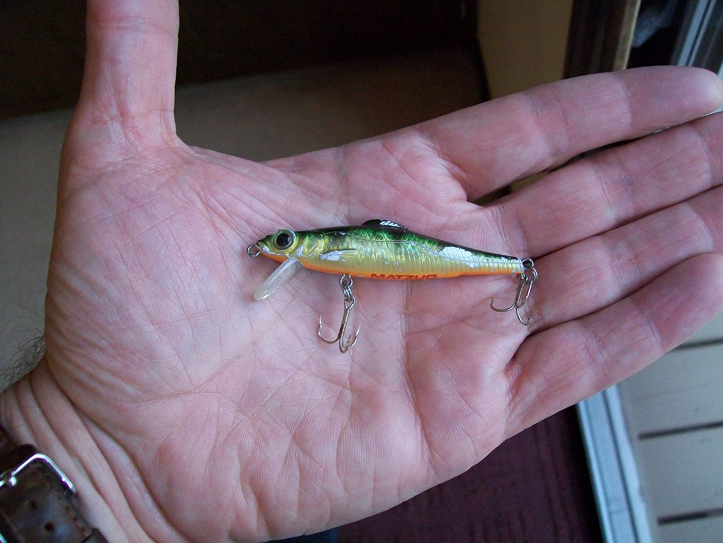
I recall another year when we trout camp regulars were disgusted by the rising price of our “standard trout lures” and experimented with new lures by Japanese companies. The Japanese get creative and have made a huge impact on the professional BASS tour. Some lures are reminiscent of their monster movies although this one reminds me of the Nautilus from 2000 Leagues under the Sea.

As you can see the lure has a perch pattern and I’m pretty sure the stream trout I fish for have never seen a perch.  Or the Nautilus. Feral and I ran into this lure by accident. He had invited a buddy from Alpena to go fishing and we stopped so the guy could buy a couple lures. He wasn’t a trout fisherman and chose this to our dismay. Once on the stream we watched him pull in trout after trout while we shook our heads and tossed old standards without luck. So there’s a good clue. Trout aren’t afraid to change their diet. Generally speaking – they are after an easy meal.

A Wasted (fish) Life

Natch with one for the skillet

I hate to release a trout I think won’t survive. In Michigan there are minimum size limits for various trout species and it seems like the aggressive undersize trout are the ones most likely to perish from unhooking and handling. Unfortunately, if you are caught with an undersize trout you could face a fine – maybe even lose your license. So there is the dilemma – let the trout go when you know he may die or take it home to eat and risk a fine.  This may be a case where a little common sense may improve the law – allow a single undersize fish in the creel. Trust the angler to make a judgment call about the condition of the fish.

Larger fish are usually pretty tough. I have caught trout with a patch over one eye and their left pectoral fin tied behind their back, so survival rate is pretty good after they hit about fifteen inches. It is the duty of these experienced fish to teach the young ones about the various lures and how to recognize a treble hook, but I suspect the tough economy has had a trickle down effect so and more and more little trout have to fend for themselves without the sage advice of their elders.  The scary hook jawed trout wearing eye patches may offer advice at the stream corner but if little trout are like little people, their mommas told them not to talk to strangers.

From what I have seen there are no shortage of little trout – at least on the streams I fish. That may have a lot to do with the good management of the resource, or, more likely, on the ability of nature to replenish itself in spite of man.

I fished a steam about fifteen years back that crossed a major highway straddled by farm country. It was small, maybe ten to twelve feet wide with some mix of bottom including gravel and some very sandy stretches.  When I stepped on the sand, bubbles of gas came up that stunk like nothing I can describe. I suspect it had something to do with chemical run off from farm land. I kept fishing and caught a few small trout but sure didn’t keep any. After about an hour I came to a sharp bend and at the head of the bend the water was channeled through a tight spot.  I tossed my lure in the backwater of the tight spot and saw the largest brown trout I’d ever seen on a small stream. He made a wake going for my lure then ducked into the deep hole in the bend. I went back once or twice hoping to see that fish again. I suspect that massive trout had a couple good stories and with the help of chemicals may have spoken proper English but I never got the chance to interview him.

Back to small trout badly hooked, and some clarification: Depending on the stream, I’d like the option to cook up the ones I think won’t make it. If they speak English and ask to be put back I’ll honor their wishes.

Refrigerator Bend

On one of our favorite streams, the Sturgeon, there is a very wide gravelly bend where the water level drops down to a foot deep that gives us a chance to relax a bit, mainly because the straight stretch leading to it is log filled and treacherous, and just above the bend the water is channeled so thin it can’t be waded because the water is over the waders. There is an old homestead on the outside bank, with only the footing remaining, along with the white shell of an old refrigerator. I am trying to remember if the fridge is still there or if I have become so numb to it that it doesn’t register any more. It could be someone dragged it away and I’ll thank whoever did it, even though we may need a new name for that spot in the river.

Wide flats like that one are pretty unusual in the Sturgeon – it may be forty feet across. The outside has some log structure and I normally pass right by it without making a cast even though the structure likely holds trout. In my mind, it’s a great spot for fly fishermen since it is so open, but not necessarily a good spot to find the larger trout I’m after. If it’s raining I can’t wait to pass by it just to get to the deep channel upstream where I’ve seen trout in the two foot class.

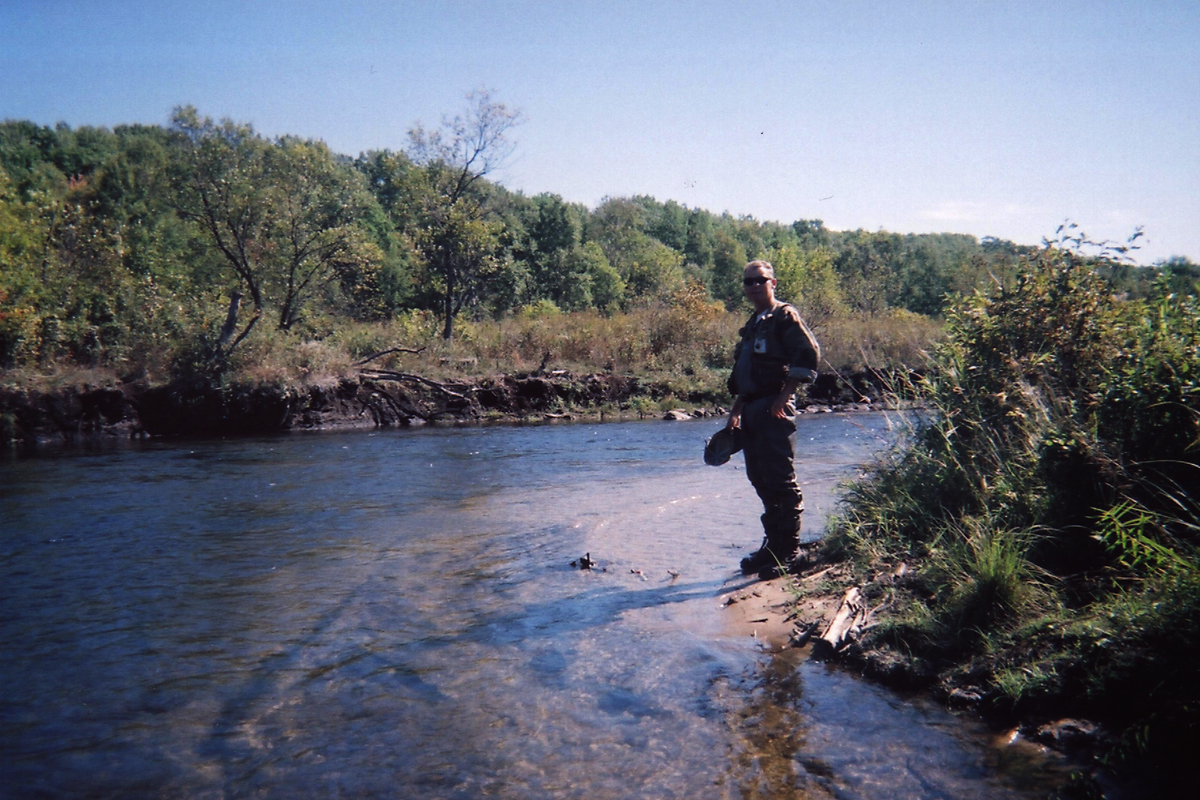
That’s Feral in the picture, taken back in 05. I suspect it wasn’t much of a fishing day with the blue sky. There’s a good chance we had a cold beer with us and that would have been the place we stopped. I can almost feel the cool breeze from the river, maybe even fooling us into thinking the sun was not a problem, only to notice sunburned ears later. I’d like to make that same trip again this year whatever the weather, if only because the Sturgeon offers such a great variety of holes, flats, deep bends and places where you just know a trophy brown will rise up and surprise you.

Against the Odds Trout

We had a short but interesting trout camp this spring made even more so by the flooded rivers. Not a typical high water mark – actual flooding. The city of Baldwin made calls to city residents to warn them. Small town goodwill!

After setting up camp Feral and I went out to inspect the local streams. The Baldwin River, one of Michigan’s great trout streams, is a tributary to the Pere Marquette. It usually runs one to three feet deep with scattered holes that might go above the waders. Since we knew it was flooded we went upstream where the river is typically brush congested and tiny – five or six feet across and a foot deep. We thought we might be able to get in and wade. There is an access point on Foreman Road east of town that Feral sometimes fishes so we pulled in there first.

Feral standing by the new Baldwin Lake

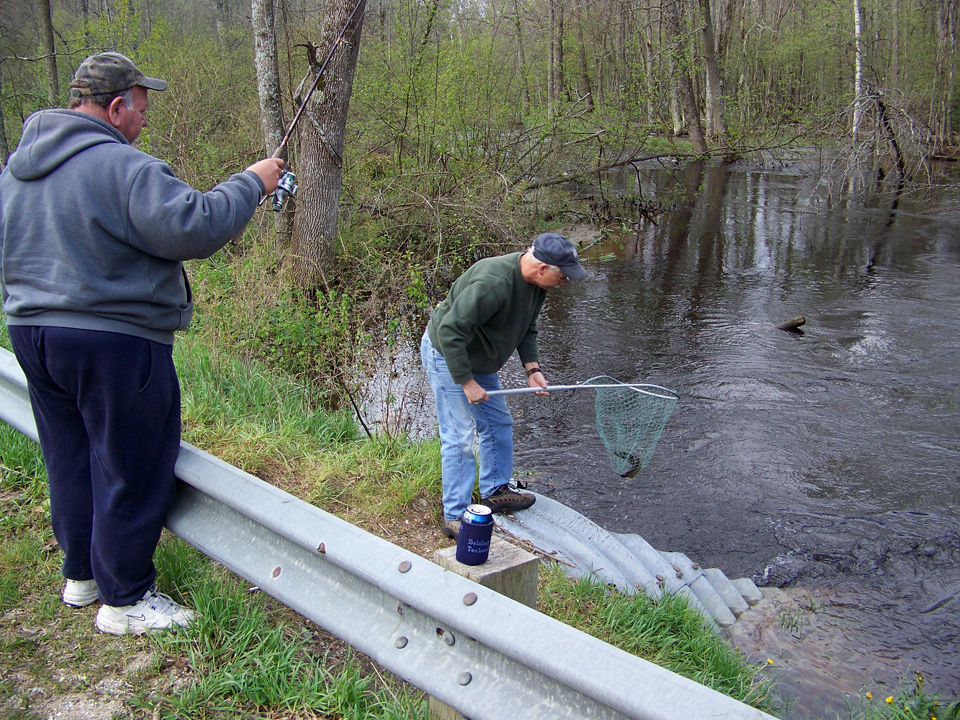
It was so flooded we couldn’t see where the normal river channel flowed.  We drove north on Foreman Road a little further and saw some guys at the bridge where the Baldwin crosses and pulled over just in time to see one guy running for his truck to get a net. We managed to get pictures of them landing a nice brown. They were pretty talkative and we got to know them a bit – Ron Walker and John Leitz, a couple retired guys that worked at the Fridgidaire Plant in Greenville. They had some good stories. They travel all over Michigan fishing for any game fish you can name.  I give them a lot of credit to doing whatever works including chunking crawlers off a bridge in a flood.

John Leitz and Ron Walker

I looked at their brown trout and my first thought was why does that fish look pregnant?  Its belly was that distorted (though it’s hard to see in the photo). After they unhooked the trout it regurgitated a handful of night crawlers. So if you wonder why it’s hard to get a trout interested in lures right after a good rain there was a graphic example. No room for dessert.

Shakespeare Wonderod

Back when Shakespeare was on the cutting edge of fishing equipment and my grandfather was doing trick casting demonstrations for them at trade shows, they would send Jake free equipment to try out. He stored his arsenal of fishing rods on a rod rack on a wall of his bedroom. Grandma didn’t complain that I know of but those were different times and I can’t imagine what my wife would say. As a little boy the fishing rods were a great source of interest to me and sneaking into his bedroom to look at them was a regular occurrence.

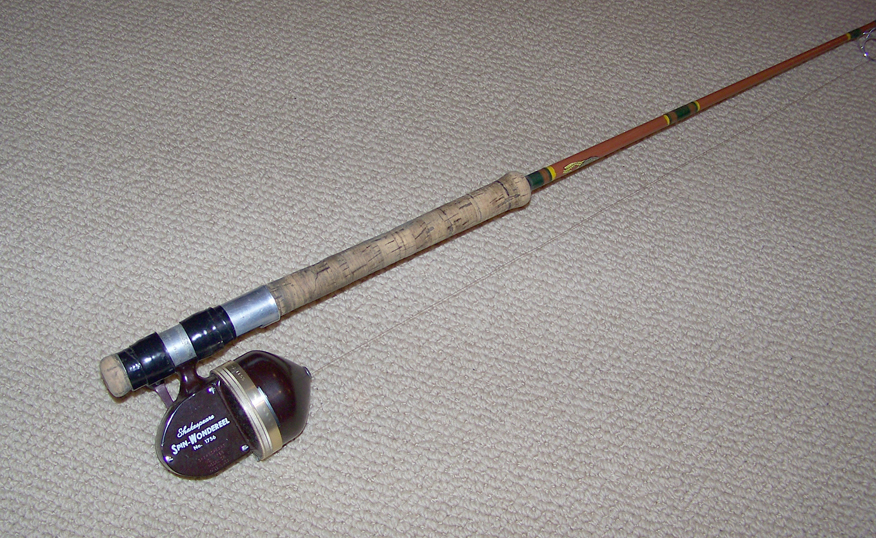
Jake had a favorite set-up – his “go to” rod and reel for most trout fishing and after he passed away it fell into my hands. I store the rod and reel in an old case and have not been tempted to use it even though as a kid I would have done anything to get my hands on it. The brown Wonderod stood out on his rod rack  and had a certain mystique mainly because over the years we associated that rod with Grandpa and many creels full of trout. It was like Minnesota Fat’s pool cue – there must be magic in it.

Back then fiberglass was the new thing – does that date this story? The rod was designed to go with the company’s closed face spinning reels, notably the 1810 and the 1756. The rod has a sliding reel seat over a lengthy cork handle and when the reel is attached it is attached at the butt of the handle. This allows the user to pinch the fishing line against the cork handle before releasing the bail. After the bail is released the cast is made and line released using the index finger – allowing great control over when to release the line and thereby helping casting accuracy. The line is stopped by using the same index finger to pinch the line against the handle – so the caster can stop the lure mid-air over the target. Jake achieved deadly accuracy (trout Point of View) using this set-up along with his underhand flip cast.

If you are a fisherman and ever wondered why 1810 and 1756 reels are mounted so close to the rod, that is the reason – so the line is easy to pinch against the rod handle. Modern spinning reels are mounted a good distance from the rod making manual control over the line almost impossible. I keep waiting for a tackle manufacturer to figure this out but I won’t hold my breath.

I am considering using Jake’s brown Wonderod and 1756 reel this spring as I know there is still some magic there and it will make my brothers jealous.  Note to myself: lock pole in trunk when not in use.

Al

When Feral and I first started camping on Michigan’s trout season opener, a long time ago, we camped on a bluff overlooking the Pine River in Lake County. We had a friend from childhood join us for the first couple years, he passed away, but I think about him now and then. Al loved to hunt and fish. He was a bit of a rogue – never holding on to employment long, made do day-to-day, was generous with whatever he possessed even though it was never much, and was fun to be around.

Back then we were very ambitious about opening day and would go down to the river at the strike of midnight to fish. This usually involved some beer, crawlers, and warm clothing including waders. Just down the hill from camp there was a nice bend of deep water that allowed us to toss the crawlers and set up fork sticks, or just fish by feel as the crawlers washed across the sandy bottom. We were not expert wormers but we usually caught a few trout. The bank there had lush grass and we would set a lantern up far enough back from the river to avoid spooking the fish. We could see our shadows against the tall bank opposite us. It was usually cold enough to see our breath, but maybe because of the beer, maybe because of the anticipation of trout, we could forget the cold and concentrate on the goodness of the gathering and joke about anything.

Al made do with his fishing equipment. Where Feral and I would try to use just enough hook and sinker to present a crawler to wary trout, Al would launch a concoction of spinners rigged to a home made crawler harness loaded down with metal objects like keys instead of lead. He would usually have a fishing pole best described as used – most likely acquired though some barter the day before the trip.

I recall one time in particular where we had a pretty slow night up until Al hooked up on a big fish. If I remember right, his fishing pole was a two piece and on setting the hook it became two pieces with the end of the rod sliding down the monofilament into the stream. Catching trout at night is never pretty, but Al trying to land this fish with half a pole set a new standard. He said the fish was a big and we believed him since only a large fish was likely to move the conglomeration of hardware attached to the end of his line. We all imagined a giant hook-jawed brown trout. We knew the Pine was capable of giving up such monsters and we were ready to witness it.

Al was standing on the bank and I don’t recall if he had waders but the next thing we saw was him jumping in the stream and going after the fish. He was able to control the fish with half a pole so the construct of hooks were doing their job. He fought the fish like a man possessed and in no time he managed to pull it near the bank. He reached down and lifted up, to our surprise, a five pound sucker.

I am sure Feral had some encouraging, heartfelt words of consolation for Al but those have been long forgotten. The event was the highlight of the trip – but is just one of many stories where Al provided something extra to make a gathering special.  RIP Al. You were a true fisherman.

For those who remember Al and his love of the outdoors, here is a painting I did in 2004 of Al and Feral, painted from a photo taken during archery deer season, most likely in the late 70’s. Al was an avid bow hunter as well as fishermen.  Those were such fun times!

Allen Zoppa & Feral Tweed

Allen Zoppa & Feral Tweed

Manistee River Brown Trout

Natch has been joining Feral and me for trout camp going on about fifteen years. He’s had a couple of interesting nicknames including one that had to do with burning wolmanized lumber in camp but that’s another story. Fall trout camp 2011 didn’t fall together but Natch, like the rest of us, made a year-end foray to a local stream late in September. I’ll let him tell it.

  Natch:

Since it sounded like the closer might be rather thin on bodies this year I chose to do some insulation work up north at the cabin. However, I did rip off a 3-hour stretch on the Manistee River near M-72. I had never been down that way and thought I would check the water out. It runs pretty shallow with a few small holes under some brush and logs. It was overcast when I started but became sunny halfway into the stretch. I saw plenty of little ones (10″-12″) that would come out from underneath cover but not aggressive enough to actually hit the lure. After about a half-hour I noticed a college-age guy walking along the bank up top on a trail. He was carrying a clipboard and wanted to know if I would answer a few questions like “what are you fishing for? Keeping or releasing? What bait?” etc. As he walked away I caught a 12 inch Brown and he came back to check it out.

I continued fishing in hopes of seeing some deep water. An hour or so later, I came around a bend with a long straight away and a few cabins.  Jutting about 20 feet out from the other side of the river was a massive log – a good 3 feet in diameter. The water was rushing under it causing a nice wash out. I placed a cast tight up under some brush along the front edge of the log and reeled in my double-hook silver minnow.  About halfway back the lure dropped under the log. Bam! I was hung up with no hopes of getting my favorite lure back. Or so I thought. All of a sudden my line headed upstream. The fish came to rest in the middle of the river. I slowly approached with net in hand. Just as I reached for him, splash! Off he went back toward the log. My heart was pounding as my drag started to slip. I still wasn’t sure if this was my 20+ inch trout or not. After a couple of tense minutes, I landed him. The tape measure read 19″.

It wasn’t the 20″ class trout that continues to elude me but it made my adventure on a new stretch of stream well worth it. I released the trout and continued for a few more bends. Nothing,  so I headed back. When I came to the log I debated on whether to give it another whirl.  I noticed two fly fishermen just around the bend so I gave it a few minutes of casting and headed back to the truck.

The Monster Brown

This story by Feral Tweed  captures the excitement and drama of spin fishing for trout – a lone angler returns to a favorite stretch in hopes of catching a lunker he saw on his last trip. Feral’s metaphors are wonderful!  – Published by permission, copyright 2011 Feral Tweed.

The Monster Brown

by Feral Tweed

Dawn was still two hours away as I slipped my oId pickup into gear and turned my wipers on. The memory of my previous fishing trip was still fresh on my mind. Was that a brown trout I saw breaking the surface of that deep shining pool or was it a leftover steelhead? Though I knew there were a few remaining steelhead in the stream, I was convinced, then, that it had been a large brown, and this morning I hoped to find out. If only the rain would hold out, I thought, and if only the brown is still there.

I have always been a stream fisherman but I have never caught a brown trout larger than 18 inches. If I was right about the fish I had seen in the pool last weekend, I now had a chance at a brown that must be well over the magic twenty inch mark.

My headlights were getting dimmer and dimmer with each passing mud hole but I was alone on the road and could see well enough. My old metal tackle box was competing in a noisy contest with my broken exhaust pipe as I throttled my truck over the flooded two-track. I was heading to a spot on top of a large hill that overlooked a four hour stretch on the south branch of the Pine River in Alcona County. It’s still plenty dark I thought to myself as I jumped around like a circus performer trying to get into my chest waders- without putting either of my feet down on the rain soaked ground. Searching through the jumbled mass of hooks and lures that used to be my neat and orderly tackle box, I finally came up with my hand painted brook trout look-alike Rapala and couple of Mepps #2 bronze spinners. I stashed these in my breast pouch, picked up my rod and landing net, and headed down the dim leaf-covered path that led across the oak ridge and down through the cedar swamp to the stream.

The sound of the rain and my beating heart was all that I could hear as I made my way through the tangled mess of blown down cedars. I had to double back several times before I finally found an opening through the mess and made my way to the swift running stream. Halting there to catch my breath, I turned to listen to the mournful cry of a great horned owl somewhere out in the darkness. Hunting for her must be tough in this rain I thought, with all the mice and ground animals snug in a nest somewhere. She probably spent most of her night gliding silently from tree to tree searching for feathered prey roosting among the branches. She’d be giving up soon, I thought. I smiled. For me the hunt was just beginning. I lit my pipe and rigged up my rod.

This lure should do it, I thought as I tied a three inch Rapala securely to my new six pound test line. I don’t normally use lures this large on a brook trout stream but the spring rains should have brought the larger trout up from the main branch down below, and I was after larger trout on this trip. One trout above all, was the monster brown I had seen the week before.

Slipping down into the cold black water I could see that I was about one hundred yards below the deep pool that held the monster brown on my last visit. I tossed an under hand cast up and across the stream to the opposite bank. I watched with anticipation as my lure twitched seductively on the surface of the rain dappled water, then down into the current as it came past me. Taking up my line I tossed another cast upstream that fell just three feet from the bank. As I took up the slack in my line, my lure was smashed instantly by a nice brook trout that leaped several times into the air before I could get him under control and pull him downstream and away from the hole. The twelve inch brookie was a nice surprise. I slipped him carefully back into the water and moved slowly upstream towards the hole where I hoped to find the monster brown. I tried several more casts with no luck.

Stopping below the pool I worked out my strategy. Just in front of me were two half submerged cedars lying directly across the stream. Above the cedars lay the pool with the stream turning sharply off to the right. Over to the left where the cedars struck the bank the water was close to five feet deep and the current dug down fast and deep under the tangled mass of debris left there by the spring thaw. In order to get my lure down under the jam, where I expected the monster to be, I would have to make the long cast upstream and across. Then I would have to let my lure ride the surface down along the far bank and start working it back just as it hit the jam. Hopefully it would dig down under the cover and entice the large trout out of his seemingly impenetrable hiding place.

Luck was with me as I made the cast. My lure touched down easily just inches from the opposite bank, well upstream of the pool. I watched it silently as it slid downstream occasionally bumping into weeds that were hanging off the bank. A perfect cast is always rewarded, I thought to myself as I took up the slack line. Then I swung my rod out and down and watched as my lure dove beneath the surface of the water just inches in front of the log jam. I was rewarded instantly by the steady throbbing of the well tuned rapala as it shifted its course and dug down for the upstream run.

Was the monster down there watching? Was he hungry after a full night of constant rain? Where is he, I wondered, as my lure came out from under the log jam. I didn’t have to wonder long. There he was sliding through the cold water like a u-boat homing in on my rapala. A shudder went through my body the instant before he struck. Then, he was on!

I set the hooks hard driven by more shear panic than good judgment.  I couldn’t believe the size of the monster. He didn’t run with my lure – he just rolled sideways in the current and shook his mighty head back and fourth like a large dog shaking an unlucky cat. My heart was racing as I regained my senses and plunged the rod tip over the cedars and into the stream in a frenzied attempt to keep from breaking my line. Don’t go downstream, I hollered. Don’t go downstream.  The brown replied swiftly by making a mad dash back across to the security of the log jam. No, no, not there either, I hollered. I could imaging all kinds of things under there he could hang himself up on. I swung my rod tip upstream to hold him and managed to get one foot over the cedars before he made a spectacular leap and hit the water on a dead run straight upstream. Shoot. I was astraddle the two cedars with neither foot on the bottom and fighting for balance and I watched in desperation as the line peeled steadily off my reel sending a spray of mist with it. Somewhere upstream I heard the monster break the surface. Freeing myself from the cedars, I plunged into the pool, all thoughts of personal safety and plain human comfort behind me. With no more than two quarts of freezing trout stream down the front of my waders I made it through the pool.

Again I heard the fish leap. Cranking for all I was worth I made my way up to a straight-away that was covered over the top and two sides by thick brush.  Ducking through a low tunnel, I came up to a pool below a beaver dam. There was my monster brown finning easily on a gravel bar contemplating his next move. I was perhaps twenty feet behind him waiting nervously like a bird dog on a hot point. I could see my lure hanging from his long hooked lower jaw. A large male, I thought to myself, all of twenty five inches. My landing net was fastened to a loop on the back of my waders. I would have to reach around with my left hand for it and let go of my reel in the process. I decided to take up some slack in my line first and get a little closer to the fish.

That was my mistake. The moment I moved out of the opening to the deep stretch behind me the monster came to life. I half jumped out of the way as he turned and came down by me. Unable to keep a tight line on him, I watched in desperation as he went by me into the tunnel of swift moving water. For an instant I lost all contact with the fish. Fearing what I knew was going to happen, I raised my rod tip high over my head hoping I would be able to break his run without losing him.

Then he was there. It all seemed to happen in slow motion. First, my rod tip plunged down from overhead splashing against the water in front of me.  Then, down in the tunnel, I watched as the monster brown, framed by the overhead canopy of lush green vegetation, rose mightily from the surface against the straining line. For an instant the brown was clear of the water shaking back and forth like a John Deere at a tractor pull. Then my lure was sailing through the air and up into the brush. Instantly the monster was under the surface and gone. The stream swallowed him up as if he had never been there.

I stood silently, watching as my dreams and heart were swept away in the turbulent water. Then I noticed the rain falling and heard the birds singing their morning songs in the cedars around me. I turned to face upstream and realized that I still had a three hour stretch in front of me. Who could tell, there might even be another monster brown out there waiting for me.

Quicksand in Michigan Streams

Everything I know about quicksand I learned from Tarzan movies. The main thing to know is: bad guys don’t make it out, but good guys and gals always do. If you’re a bad guy, please stop reading. Quicksand on a trout stream is a little different than sand bogs in Africa, but there’s some similarity. They are both camouflaged so you don’t see it until it’s too late and if you make it out alive you’ll have an interesting story to tell even if no one believes you.

Quicksand on a trout stream is harder to see since it’s underwater. The stream bottom appears normal except there is no visible hole (sand covers it) so you don’t know it’s here until you start sinking. In waders it’s pretty scary since swimming doesn’t feel like an option.

I’ve found quicksand on the Pine River in Lake County and the Sturgeon River in the Pigeon River State Game Area. On the Pine, the particular spot I know of is a few bends downstream from Raymond Road. The first time I ran into it I was alone. I scrambled to get out and it was like running in place up a sand dune. It was easy to see the exact spot afterwards because a cloud of light gray silt poured out like smoke.  An hour later, walking the bank downstream, the silt was still pouring out.

A couple years later I fished the same stretch with Feral Tweed and mentioned it to him right before we got there (it was hard to forget). I was in the lead and sure enough I stepped into it and the same thing happened. Here again, I didn’t see the hole – it looked just like the rest of the sandy stream bottom.  A film of sand over the hole made it invisible.

The Sturgeon River has at least one spot I know of in the section they call the Valley which is upstream of the notorious Ford property. The same thing happens, but without the silt pouring out. How dangerous it is I don’t know. You start sinking and your reactions take over. This spot is near the left bank (fishing upstream) opposite and below a couple giant evergreen trees that lean out over the water from right the bank. If the stream is low it’s easy enough to wade around (since I know the exact spot), but with high water I get out on the bank and get back in above it.

How prevalent and dangerous are these quicksand spots?  If you are careful wading, meaning testing each step which you should be doing anyway, then you will likely get off with a small adrenaline rush and some exercise. Best not count on Tarzan to rescue you. He’s busy.

Feeder Creeks

Feral on undisclosed feeder creek

Some of the best spin fishing can be found on the small creeks eight to twelve feet wide that feed the streams made famous by the Hemingway’s of the world. They don’t get much traffic other than an occasional worm fisherman because casting is next to impossible. If you can cast and send lures horizontally into tiny pockets there is hope. Having been taught by an expert (Jake Lucas) that performed trick casting on Michigan Outdoors in the 1960’s helps in my case. Along with untold years of doing just that: casting into difficult cover.

When possible, fish feeder creeks during a summer rain, enough to boil the water or at least dapple it enough so trout don’t see you standing there. Feeder creeks come alive during a summer rain and can provide the best action you will see for the year. In the summer a sixteen inch fish is good, in the fall when the weather turns nasty and the closer approaches, big fish move out of the main stream and up the feeder creeks to find food. For years I travelled long distances to fish the famous and noted water during the summer and then caught my best fish of the year on a local feeder creek. In Michigan, you don’t have to drive far to find feeder creeks since major rivers crisscross the state.

Rain helps but you can also do well early morning or late evening. The trout are usually aggressive for any lures because the competition for food is great, and the trout are not as suspicious of lures as they are on the main rivers. They will stray away from their cover into the main stream channel for a sizable or flashy (think spinners) meal. While I mainly find brown trout on feeder creeks, there is a good chance of catching brook trout the further you go upstream. Catching a brook trout is like stepping back in time, back before the brown trout plantings and the later steelhead and salmon stocking. I don’t keep brook trout. I look them over, enjoy their beauty, and turn them back. Just seeing one is enough.

Post Navigation