Fichigan

Small Stream Trout fishing in Michigan

Quicksand in Michigan Streams

Everything I know about quicksand I learned from Tarzan movies. The main thing to know is: bad guys don’t make it out, but good guys and gals always do. If you’re a bad guy, please stop reading. Quicksand on a trout stream is a little different than sand bogs in Africa, but there’s some similarity. They are both camouflaged so you don’t see it until it’s too late and if you make it out alive you’ll have an interesting story to tell even if no one believes you.

Quicksand on a trout stream is harder to see since it’s underwater. The stream bottom appears normal except there is no visible hole (sand covers it) so you don’t know it’s here until you start sinking. In waders it’s pretty scary since swimming doesn’t feel like an option.

I’ve found quicksand on the Pine River in Lake County and the Sturgeon River in the Pigeon River State Game Area. On the Pine, the particular spot I know of is a few bends downstream from Raymond Road. The first time I ran into it I was alone. I scrambled to get out and it was like running in place up a sand dune. It was easy to see the exact spot afterwards because a cloud of light gray silt poured out like smoke.  An hour later, walking the bank downstream, the silt was still pouring out.

A couple years later I fished the same stretch with Feral Tweed and mentioned it to him right before we got there (it was hard to forget). I was in the lead and sure enough I stepped into it and the same thing happened. Here again, I didn’t see the hole – it looked just like the rest of the sandy stream bottom.  A film of sand over the hole made it invisible.

The Sturgeon River has at least one spot I know of in the section they call the Valley which is upstream of the notorious Ford property. The same thing happens, but without the silt pouring out. How dangerous it is I don’t know. You start sinking and your reactions take over. This spot is near the left bank (fishing upstream) opposite and below a couple giant evergreen trees that lean out over the water from right the bank. If the stream is low it’s easy enough to wade around (since I know the exact spot), but with high water I get out on the bank and get back in above it.

How prevalent and dangerous are these quicksand spots?  If you are careful wading, meaning testing each step which you should be doing anyway, then you will likely get off with a small adrenaline rush and some exercise. Best not count on Tarzan to rescue you. He’s busy.

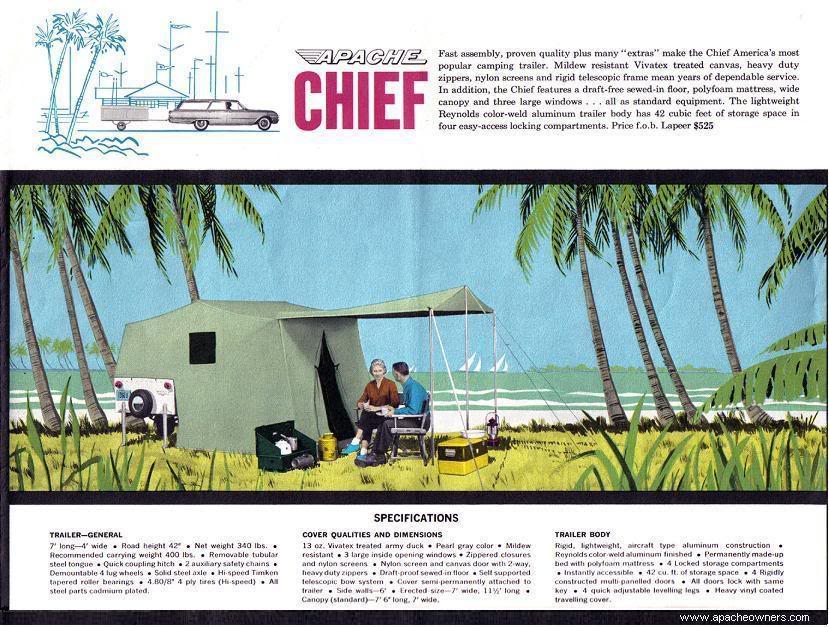
1961 Apache Chief Tent Camper

Camping near Grass Lake marsh

I found the tent camper pictured above in the want ads for $200.00.  I won’t say when, but I will say I have owned it longer than the original owners, so that would make me older than the camper. They took great care of it and their main advice was never put it away wet. I took that advice and after all these years the canvass is still 100%.

It’s a great piece of engineering. It has an aluminum box on wheels with doors on the side for storage, a mattress on top of the box, and a full size tent with attached collapsible tent poles that fold over the mattress for storage. The mattress keeps me off the ground in cold weather, it absolutely doesn’t leak, there is room for two more guys on the floor plus an aisle down the middle so it’s roomy enough for three if need be. The storage compartments handle all my camping gear including sleeping bags, a screen tent, tarps, cookware, tackle and tool boxes, etc. In bad weather, which can happen at either end of Michigan’s trout season, it stays warm inside with just a propane lantern.

There is a coolness factor to owning and using something this old. People ask about it at campgrounds and want to look inside. Apache had a great idea. I guess the popularity of dinette campers convinced them to abandon the idea. That’s really too bad since it is such a practical design.

Around ten years ago Feral bought a similar used camper of a different brand. Feral painted some Ghost Brown Trout on the box, inspired by a humorous rewrite of the classic cowboy song “Ghost Riders in the Sky.”

(see youtube for the video “ghost brown trout.” Feral does some mean electric mandolin, Luther on vocals.)

Update: This camper is a 1960 JC Higgens, manufactured by the same company (Vesely Mfg.) for Sears. It is very similar or identical to the  1960/61 Apache Scout.

1961 Apache Scout - click on image to enlarge

1961 Apache Chief

If you see these tent campers together at a campground or remote spot somewhere in northern Michigan, stop in and say hello. We’re friendly. If you like to eat trout we may have some extra in the cooler you can take home for your dinner.

Pickerel Lake

Natch and Feral check out Pickerel Lake

The Pigeon River State Game Area in the northern lower peninsula of Michigan is home to some great trout streams and also some nice lakes including Pickerel Lake which has a campground and boat launch (unpaved for row boats and canoes). There’s a sandy swimming area but it’s not a beach proper where the sand extends beyond the lake. Most people lay out blankets on a grassy area near the boat launch and swim there.

The lake has a variety of fish species including rainbow trout, bass, perch and bluegill. A couple of us trout fishermen stopped at the boat launch one night and talked with a guy who pulled up in his row boat. He showed us his catch and he had a respectable number of decent bluegills and a few trout.

The next evening, as a social endeavor, we decided to try fishing the lake from the shore which allowed us to gab while experimenting to see what might work for the trout. A pair of Loons was working the lake and having much better luck than ourselves – so we waded out from the boat launch and tossed our crawlers out past the drop off. We stripped out line and went back to shore and set up some forked sticks and waited. It didn’t seem like we had the right program until we got ready to leave and found three fish on our various lines including a bass, a perch, and a rainbow. By then it was dark but we learned a lesson – hold onto the line and feel for the strike.

Working the shoreline at Pickerel Lake

A year later we tried it again. This time we worked the shoreline by the campground and caught a respectable number of bass, bluegill, and a few trout. Here again it was more of a social engagement, lots of jabs, a cold beer, and a chance to fish a different way than the more serious solo trout fishing we do on the trout streams. The lake produces fish easily. Use crawlers or worms with or without a bobber. Someday I’d like to take a boat out on the lake and explore, fish the drop-offs, and cast for bass.

The DNR made some improvements to the campground a year ago in hopes of luring more campers. If you are thinking about checking out the Pigeon River area it is a nice spot to camp for fifteen dollars a night. There’s a ranger station further up Sturgeon Valley Road (turn left on Twin Lakes Road after you cross the Pigeon River) that provides free maps of the two tracks and hiking trails. Driving around in the morning or evening you can see deer and elk. I’ve seen some postcard bull elk just driving around.

Pickerel Lake is centrally located to some of the best trout streams in the state including the Pigeon and the Sturgeon. Fishing the lake in the evening is a nice change of pace from wading and casting streams.

Witching Hour Trout

Luther and Feral after dark

If you are like me it is hard to stop fishing as the sun creeps to the horizon even when you know that walking out in the dark will be a bad trip. If I am fishing with someone else, like Feral, it is doubly hard because I know if I fall into a beaver hole and break a leg he’ll get me out or at least can direct someone back to the spot. I imagine he’ll recast some of the better holes on the way out, but eventually someone will come for me.

It’s true you can catch big trout during the day, especially in stained or muddy water, but nightfall offers trout free rein of the stream. They stop worrying about Osprey or other predators. They like the cover of darkness and that’s when the larger fish move out to center stream and go on the hunt.

I recall a time on the Pigeon, before the fish kill from the Song of the Morning dam, when Feral and I did an evening stretch by walking down stream and fishing back upstream past where we had parked. It was getting dark and we didn’t want to stop even though we knew we would have to walk out through saplings thick as spaghetti growing in a mud bog with beaver holes (near the stream) that were hidden by lush tangled saw grass. The stream itself had beaver dams spanning the stream and places you had to climb out and try to slip back into deep water, then do a wader dance on tip toes to get to solid footing. I hope I painted that picture clear enough – some places aren’t really made for wading, and after dark you need a special mindset called denial.

We knew there was a nice bend upstream that held good fish and we were not disappointed. The bend had a straight section leading up to it that had overhanging grass and saplings but was clear and open enough for working good casts right to the bank. From there it veered slowly to the left with the same cover overhanging brush and some various stumps and trash that broke up the stream flow enough to be big trout holding places.

When Feral and I fish together we have a system where one guy takes the lead until he gets a fish, or for one or two bends, in which case he is embarrassed enough at not catching anything he reluctantly offers the lead back to the other guy. When the lights go down this unseemly gentleman behavior goes out the window and we scientifically determine who leads by reviewing who has done the best so far and maybe the other guy should get a chance. On this night it didn’t matter who went first because we caught several fish out of the same bend. It happens like that sometimes. The fish cooperate and the fishermen don’t fall in a beaver hole on the way out.

Guitars and Trout Fishing

Bray Creek campground was empty except for Mike and Denny. They were gone but we recognized Mike’s pop up camper. Feral and I pulled in late afternoon with our tents and set up. This was a couple years ago.

Bray Creek campground is on the Baldwin River in Lake County, Michigan. At the upper end of the campground Bray Creek feeds into the Baldwin making a pool that is slightly warmer than the rest of the river, and almost deep enough for a swim. As kids camping with our grandpa, we fished Bray Creek for chubs as the water was too warm for trout. I caught my first trout on the Baldwin.

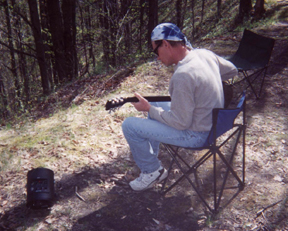
Feral and I brought guitars, including my Les Paul Studio electric and my battery powered Fender Amp Can which looks like a coffee can on steroids. I also brought my zoom pedal which provides a variety of guitar voices including some pretty ragged distortion that sustains till Monday. Feral brought a jumbo bodied acoustic of unknown brand that sounded sweet with plenty of volume and low end.

Mike and Denny showed up toward evening and we still had the campground to ourselves so we pulled out the guitars. Feral and I have been playing together a long time so we dug into some of our old stuff, and, as happens most times we get together, I handed him the electric. Since Denny was there, maybe Neil Young’s most devoted fan, we decided to try “Down by the River,” a classic mostly in E minor though I’m no student of music theory. It’s one of those songs that you can do a short version or you can do the long version with a lot of “out there” lead guitar. Feral was up for the challenge. We started out slow with Denny and I trying to reach those high vocals that Neil Young can manage with ease but in my case leaves me hoarse for the next few days. Feral soared on the guitar going places I didn’t know he could go – triple picking leads in a wall of distortion at decibels that would have stopped cars on Highway 10.

We did some of our other standards too but Down by the River was the standout. I know we’ll never do a better job on that song.

We knocked down a few beers that night and slept well. I suspect we fished the Baldwin the next day but for some reason the only thing I remember is the guitar jam and Feral treading new ground on a song played to death by bar bands in the seventies. Feral’s also pretty good on a trout stream. Maybe it helps he’s a musician.

Feeder Creeks

Feral on undisclosed feeder creek

Some of the best spin fishing can be found on the small creeks eight to twelve feet wide that feed the streams made famous by the Hemingway’s of the world. They don’t get much traffic other than an occasional worm fisherman because casting is next to impossible. If you can cast and send lures horizontally into tiny pockets there is hope. Having been taught by an expert (Jake Lucas) that performed trick casting on Michigan Outdoors in the 1960’s helps in my case. Along with untold years of doing just that: casting into difficult cover.

When possible, fish feeder creeks during a summer rain, enough to boil the water or at least dapple it enough so trout don’t see you standing there. Feeder creeks come alive during a summer rain and can provide the best action you will see for the year. In the summer a sixteen inch fish is good, in the fall when the weather turns nasty and the closer approaches, big fish move out of the main stream and up the feeder creeks to find food. For years I travelled long distances to fish the famous and noted water during the summer and then caught my best fish of the year on a local feeder creek. In Michigan, you don’t have to drive far to find feeder creeks since major rivers crisscross the state.

Rain helps but you can also do well early morning or late evening. The trout are usually aggressive for any lures because the competition for food is great, and the trout are not as suspicious of lures as they are on the main rivers. They will stray away from their cover into the main stream channel for a sizable or flashy (think spinners) meal. While I mainly find brown trout on feeder creeks, there is a good chance of catching brook trout the further you go upstream. Catching a brook trout is like stepping back in time, back before the brown trout plantings and the later steelhead and salmon stocking. I don’t keep brook trout. I look them over, enjoy their beauty, and turn them back. Just seeing one is enough.

The Mepps Black Fury Spinner

I always carry a #3 Black Fury spinner with me when trout fishing. I don’t use the lure often even though I have a lot of faith in it. I’ve caught a lot of trout on this and smaller versions over the years. It was all I used on the Baldwin River when I first started spin fishing – it was that dependable.

Now I use it when I need something magical, something that makes no sense, something the trout won’t recognize but want to attack. The stream conditions and topography have to be right. I mainly use it for deep pools and runs. If the water is stained and the stream flooded, that is a bonus. The lure sinks out of sight, down where big trout hold in deep water, and can be reeled in slow because of the large blade. There is no second guessing when a trout hits it. They smash it. The single treble hook does its job – the trout stay on until landed.

Sinking out of site means you can lose the lure on hidden logs and branches. If you do get hung up, wade upstream of the snag as far as possible to leverage it off.

I also carry plain gold and silver spinners in various sizes which must look like the scales of small fish glittering in the stream. On bright days and clear streams, the glitter can entice trout out of cover even though the fish may be smallish.

Mepps also makes a version with a bucktail but I prefer no tail for trout.  For Pike fishing, I think a bucktails adds to the attraction. For trout I think the bucktail looks unnatural, though it is impossible to understand what they consider natural considering they attack Black Fury lures. I have no idea what this lure represents to them.

Trout Camp

Jake, Natch, and Feral

Twice a year I get together with friends and relatives for several days of hard core trout fishing, wilderness camping, mushroom hunting, guitar jams, and hanging out. The faces have changed over the years with exception of Feral Tweed and me. Everyone else seems to be looking older. Ha! What I mean to say is people have dropped in an out of the annual gathering, but Feral and I seem to be the constant denominator, not to mention the constant dominator on the streams. Ha again?

It is the start of a new year. The trout opener in Michigan falls on the last Saturday of April and for those of us ingrained to trout fishing, for all purposes this is our New Year. Never mind January 1 Times Square frenzy, for us it happens on a remote camping spot along a favored trout stream. There was a time we would stay up to midnight and head down to the stream with bait and a bottle of something to open the season at the first minute. We always caught trout, even though we were not bait experts. After a couple hours we would stumble back to camp and wake late morning. The morning conversation, often over breakfast at 2 star restaurant, was a strategic and tactical effort to “Call” the best stretch of stream before anyone else called it. Of course, once we got to our stretches they were already picked over by the guys that didn’t stay up till Two AM and then go out for breakfast. If you fish the Michigan opener, prepare to share. After the opener weekend, the streams are miraculously cleared of anglers and you can fish long stretches without seeing another soul.

The trout “Closer” falls on the last day of September. Lately, meaning for the last ten years, we have camped up in the Pigeon River State Game area which has three stellar trout streams, the Pigeon, the Sturgeon, and the Black. We often wilderness camp with a free permit – available at the local ranger station. If we plan on jamming with electric guitars and portable battery powered amps we know we won’t be disturbing the quiet crowds in the many campgrounds enjoying the portable generators. (We don’t always jam, and if yes, it’s usually with acoustic instruments.)

The trout closer usually provides the best fishing and worst weather, which go hand in hand. The final night includes a mess of Cajun spiced fried trout, the last of our supply of Labatt’s Blue, and the unspoken dread of another long Michigan winter waiting for the opener.

10 Tips for catching Big Trout with Spinning Gear

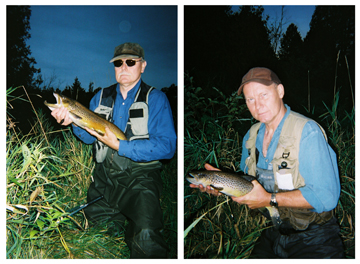
Hook-jawed Brown Trout and Hook-jawed Angler

These tips are gleamed from a lifetime of catching trout on Michigan streams, but by no means tell the whole story. The main missing ingredient here is pinpoint casting accuracy- getting the lure under over hanging branches and into pockets that seem impossible to cast to. Read the Close-faced Spinning Reels post for an idea of equipment, and I’ll write a post soon on how to do the Jake Lucas underhand flip cast. Master that, and you can place a cast where the big fish hide.

  1. Wade and cast upstream – they don’t see you coming.
  2. You can’t reel a lure fast enough to keep a trout from taking it. If it wants your lure it will get it.
  3. Trout like a big meal. I have caught trout the same length as the lure I was casting.
  4. A short cast will catch trout – work the banks and cover at all angles.
  5. Fish rising rivers, the beginning of a good rain, for the most fish.
  6. Fish late fall for the biggest fish – catch them in upper stretches of your favorite river.
  7. Try flashy spinners in muddy water and minnow baits in stained water.
  8. On bluebird days with clear streams, a trout is a bonus. Enjoy the day.
  9. Trout are hardy, but not indestructible.  Carry needle nose pliers so you can unhook and turn them back quickly. (Keep only what you need for a meal.)
  10. Visit this site for more tips!

No. I’m not a Fly Fisherman.

When I think of the many fly fishing books on the market aimed at budding trout fisherman I have to laugh. Somehow or another the idea of trout fishing got hijacked by the guys with fly rods standing outside the Orvis Shop next to their Escalade SUV’s sipping wine coolers. It’s a scientific crowd made up entirely of corporate engineers and the guys that write fly fishing books.

I am thrilled that’s my competition on a trout stream. They catch a lot of the eight to ten inch trout and are satisfied to do it. I can applaud that. They must be having fun and there’s nothing wrong with a ten inch trout… great eating, beautiful to look at, and some marginal sport.

Fly fishing involves pre-game activity which I will liken to the guys on TV right before the Superbowl. Serious men debating the virtues of a particular fly at the exact moment the actual hatch will erupt at a given time on a given stream and the likelihood of actually being there when it happens resulting in a fish that alas, might be fourteen inches. It is a friendly argument with no one really making a statement that will be contradicted later – they have their reputations to think about.

In another world there are the worm fishermen. A plastic tub of Walt’s Crawlers floats alongside bottles of Bud in a Styrofoam cooler in the back of an almost classic pick-up truck on the way to the same spot that held a trout the last opener. (I occasionally see a worm fisherman on the trout opener (last Saturday in April for Michigan) but seldom see another one the rest of the season).

For the record, I would much rather see a fly fisherman in front of me than a worm fisherman. Worm fisherman can clean up if they know what they are doing, and many do.

I belong to neither group. I was raised as a spin fisherman. We wade patiently upstream and cast lures and spinners at the cover and reel the lure back at a furious pace in order to impart action to the lure, and, for our efforts, we take the trout that the fly fishermen dream of and the worm fishermen don’t tell about. Depending on stream conditions and the time of year, that means brown trout in the two foot class. Hook jawed males with spots like leopards and fat, round females that fill nets.

Post Navigation