Fichigan

Small Stream Trout fishing in Michigan

No. I’m not a Fly Fisherman.

When I think of the many fly fishing books on the market aimed at budding trout fisherman I have to laugh. Somehow or another the idea of trout fishing got hijacked by the guys with fly rods standing outside the Orvis Shop next to their Escalade SUV’s sipping wine coolers. It’s a scientific crowd made up entirely of corporate engineers and the guys that write fly fishing books.

I am thrilled that’s my competition on a trout stream. They catch a lot of the eight to ten inch trout and are satisfied to do it. I can applaud that. They must be having fun and there’s nothing wrong with a ten inch trout… great eating, beautiful to look at, and some marginal sport.

Fly fishing involves pre-game activity which I will liken to the guys on TV right before the Superbowl. Serious men debating the virtues of a particular fly at the exact moment the actual hatch will erupt at a given time on a given stream and the likelihood of actually being there when it happens resulting in a fish that alas, might be fourteen inches. It is a friendly argument with no one really making a statement that will be contradicted later – they have their reputations to think about.

In another world there are the worm fishermen. A plastic tub of Walt’s Crawlers floats alongside bottles of Bud in a Styrofoam cooler in the back of an almost classic pick-up truck on the way to the same spot that held a trout the last opener. (I occasionally see a worm fisherman on the trout opener (last Saturday in April for Michigan) but seldom see another one the rest of the season).

For the record, I would much rather see a fly fisherman in front of me than a worm fisherman. Worm fisherman can clean up if they know what they are doing, and many do.

I belong to neither group. I was raised as a spin fisherman. We wade patiently upstream and cast lures and spinners at the cover and reel the lure back at a furious pace in order to impart action to the lure, and, for our efforts, we take the trout that the fly fishermen dream of and the worm fishermen don’t tell about. Depending on stream conditions and the time of year, that means brown trout in the two foot class. Hook jawed males with spots like leopards and fat, round females that fill nets.

Closed-face Spinning Reels

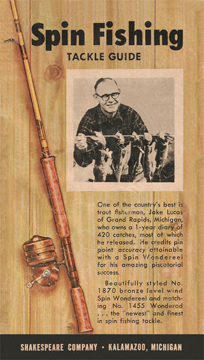
Back in the 1950’s and 60’s my grandfather, Jake Lucas, worked with the Shakespeare Company on closed faced spinning reel design, including the 1810 and other models. He was a bit of a legend – doing trick casting demonstrations at trade shows and on TV, with appearances on Michigan Outdoors hosted by Mort Neff. He would pop balloons out of the air and various other fun casting tricks.  He was quite a character, and a family man. He taught his kids and grandchildren how to do his underhand flip cast – and how to use it on a trout stream.  He pioneered a new way to catch trout using pinpoint casting while wading upstream, while the bulk of fisherman were fishing downstream tossing worms or trying their luck fly fishing.

He was extremely successful at trout fishing because he could place a tiny spinner underneath an overhanging branch across a stream in the most difficult places to reach. And set the lure down gently so as not to spook the trout. He did this with the help of the reels he designed with Shakespeare – closed face spinning reels, like the original model 1810, not to be confused with current reels using the 1810 designation. The original Shakespeare reels are collector’s items and purists are always on the lookout at garage sales and the internet.

Here is what makes the reels unique:

In order to cast the reel, the user backs up the handle a half a turn to release the bail. None of this is visible since the reel spool has a cover (hence close faced).  The reel body is placed very close to the handle of the rod, typically cork, so the user traps the line against the cork with an index finger before releasing the bail. This has several advantages – it is easy to release the line at the right millisecond when making the cast, and it is easy to stop the line with the index finger when the lure reaches the destination. You don’t cast the lure and let it plop in the water – that scares trout. You stop it mid air and inches above the water so it drops in without a splash. The reel was designed around this concept, though few anglers, even 1810 enthusiasts, understand the principals behind the design, or best use of the reels.

Jake was a pioneer in the sport of trout fishing and I occasionally run into people he knew and taught. He was generous with his time and instruction. They need only see me cast and to know where I learned. It’s always good for a conversation.

Waders 101

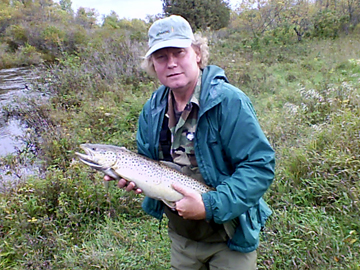
Feral Tweed with a good Brown Trout

If you are serious about small stream trout fishing you will need chest waders. Visit any large outdoor supply chain and you will find a large variety of waders you absolutely do not want to buy. And a few pair that make sense. For years I wore chest waders with a built-in boot. They were made of canvas, lasted a few years, and I could get in and out of then easily. On a scale of 10, they were about 5 for comfort and weight.  Now I wear superlight stocking foot waders with wading shoes and here is why: It’s like wearing a comfortable pair of pants. Trout fishing involves a lot of walking, a lot of grueling wading (upstream), and after that, more walking. Waders can sap your strength, make you sweat, and slow you down.

You can buy light weight waders and boots for not much more than conventional waders. My waders (Hodgeman Wadelites) and shoes ran about $100.00 on sale. See the “about” page to check out my waders. You can spend more, much more, and the investment may be worth it. Keep your receipt. My main fishing partner and trout legend, Feral Tweed, pictured above, purchased a pair of light weight Simms waders ($200+) that leaked right out of the box. This may have been the exception, as the Simms brand gets good reviews generally.

Do not worry about warmth, at least for the type of trout fishing I will be explaining in later posts. Do not buy rubber waders or waders that seem to promise you will stay warm, including neoprene. You will be on the move, even in cold spring or fall weather, and warmth is not an issue. If you think you will get cold, you can always put on a pair of long johns.

At some point, all waders leak.

Wader Repair: If your light-weight waders leak around a seam – pick up a tube of SEAMGRIP, turn the waders inside out and coat the seams. If you puncture them on a snag, waders typically have a repair kit including patches.

Post Navigation