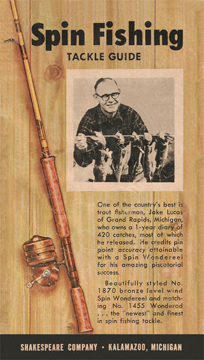
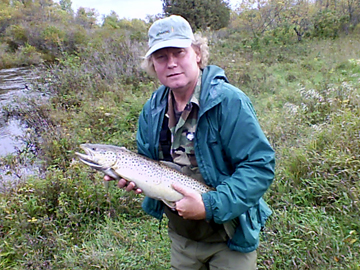
Fichigan

Small Stream Trout fishing in Michigan

Archive for the category “Trout Gear”

Fixing a Fishfinder Transducer

I know I keep veering away from trout fishing and promise to get back to it soon – but this may be important to a fisherman somewhere. I have an older model Humminbird fishfinder, a Wide Eye, from the eighties. The wires to the transducer were sheared (or pulled off) right at the transducer puck. I did some research online and found a replacement for $77.16 at Amazon, but, based on an email to Humminbird Service, I couldn’t be sure the replacement transducer works with my older model. (Service said my unit is so old there are no replacement parts and I should buy a new fishfinder – uuhhh… thanks for the advice?)

I trolled the web to see if there was a way to fix it. The word on the web is: buy a new one because you can’t repair them. I could see their point, in my case the wires I needed to reconnect are encased in the plastic compound of the puck, sort of like Hans Solo encased in Carbonite, but less to work with.

I decided to do surgery on the puck. (What did I have to lose?) The main issue was getting to the wires inside. I took a 1/8th  inch drill bit and made small holes all the way around the spot where the wires exit. I drilled just deep enough to break though the molded plastic seal. Then I chipped away the plastic until I could see the two wires, one black and one red (matching the wires encased in the cable). The wires are tiny – so extreme care has to be taken to work them free of the plastic seal. Once they were free I was able to strip the coating off the two wires using an exacto knife and a lot of patience.

Then I did the same thing with the cable end – stripped and exposed enough of the wires so I could hold and solder them to the wires in the puck. I used a pencil type soldering iron with a fine point. Once the wires were soldered I filled in the hole and soldered joints with two part epoxy. I gobbed on enough so that it covers the cable where it exits the puck. Hopefully it’s as strong as carbonite so the wires don’t pull out again.

The Test: I took the boat out on a local lake and it seems to be working better than ever. It zeroed right in on the bottom. If you are on a budget – don’t trash the transducer. Dig out and solder together the broken off wires and gob up the hole and wires with epoxy. Save yourself eighty plus dollars with very little effort.

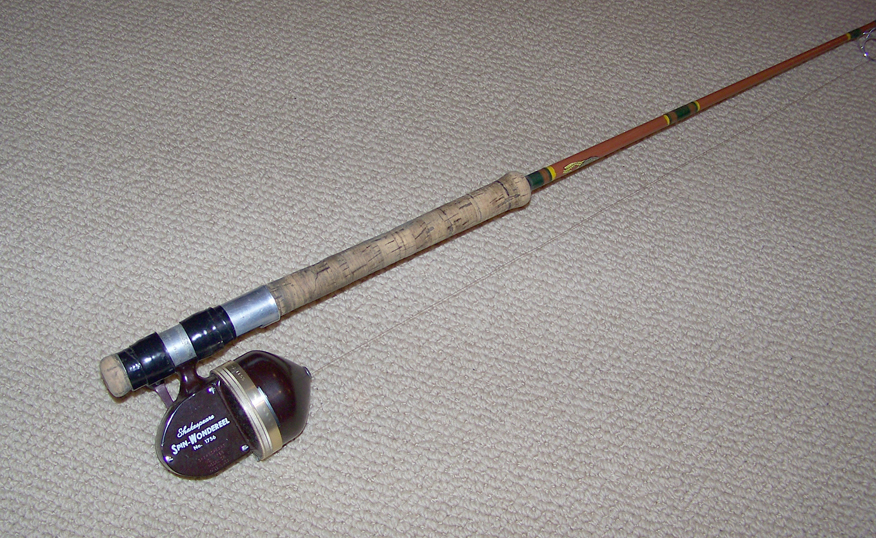
Shakespeare Wonderod

Back when Shakespeare was on the cutting edge of fishing equipment and my grandfather was doing trick casting demonstrations for them at trade shows, they would send Jake free equipment to try out. He stored his arsenal of fishing rods on a rod rack on a wall of his bedroom. Grandma didn’t complain that I know of but those were different times and I can’t imagine what my wife would say. As a little boy the fishing rods were a great source of interest to me and sneaking into his bedroom to look at them was a regular occurrence.

Jake had a favorite set-up – his “go to” rod and reel for most trout fishing and after he passed away it fell into my hands. I store the rod and reel in an old case and have not been tempted to use it even though as a kid I would have done anything to get my hands on it. The brown Wonderod stood out on his rod rack  and had a certain mystique mainly because over the years we associated that rod with Grandpa and many creels full of trout. It was like Minnesota Fat’s pool cue – there must be magic in it.

Back then fiberglass was the new thing – does that date this story? The rod was designed to go with the company’s closed face spinning reels, notably the 1810 and the 1756. The rod has a sliding reel seat over a lengthy cork handle and when the reel is attached it is attached at the butt of the handle. This allows the user to pinch the fishing line against the cork handle before releasing the bail. After the bail is released the cast is made and line released using the index finger – allowing great control over when to release the line and thereby helping casting accuracy. The line is stopped by using the same index finger to pinch the line against the handle – so the caster can stop the lure mid-air over the target. Jake achieved deadly accuracy (trout Point of View) using this set-up along with his underhand flip cast.

If you are a fisherman and ever wondered why 1810 and 1756 reels are mounted so close to the rod, that is the reason – so the line is easy to pinch against the rod handle. Modern spinning reels are mounted a good distance from the rod making manual control over the line almost impossible. I keep waiting for a tackle manufacturer to figure this out but I won’t hold my breath.

I am considering using Jake’s brown Wonderod and 1756 reel this spring as I know there is still some magic there and it will make my brothers jealous.  Note to myself: lock pole in trunk when not in use.

Trout Season Bucket List

If you are a trout fisherman the close of the general trout season in September means seven months until you get back into a trout stream. Whoa… I never added it up before … that is a long time. The following bucket list might better be called a reverse bucket list, things to do to pass time so you don’t die waiting for the last Saturday in April.

  1. Read Tom Sawyer. Seriously. You’ll laugh.
  2. Try ice fishing. Last year Feral and I tried a couple lakes and bombed entirely, so my best advice is get good advice on how and where, or better yet, talk an experienced ice fisherman into dragging you along. Dress in layers – if you start sweating it’s all over.
  3. Deer hunt. I understand the number of deer hunters decline every year and it is important to control the size of the herd – hunting solves that problem.  Note: Feral went out on opening day (gun season) and shot a six point! He had the woods to himself.  He was surprised. Michigan has seasons for archery and muzzle loading also – up to the end of December.
  4. Lose twenty pounds. (Secret: low carb diet first two weeks while starting 30 to 40 minute morning treadmill routine, 5 times per week. Ask your doctor if it makes sense for you.)
  5. Make your own spinning rod. Hmmm. I always thought that sounded fun. I believe there are rod building classes at Al and Bob’s Sporting Goods store on Division Ave.
  6. Paint a masterpiece. Ok.. this one is directed at some of my buddies that dabble in this sort of enterprise. You have a year before the next Art Prize contest in Grand Rapids and a shot at fame and fortune.
  7. Join a club. This one may sound really out there to the socially awkward loners I normally spend time with, guys like me. Still, I have tried it a few times. I joined the Grand Rapids Songwriters a few years back and had fun. Met some great people. They meet once a month and play original songs. There are groups for just about every hobby and pastime you can imagine. Take a chance?
  8. Invent something.
  9.  Change the oil in your car. Obviously, I’m struggling at this point.
  10. Buy a time machine or lapse into a seven month coma. Bingo, its trout season again.

My Short History of Bass Tournaments

Reeds Lake 1951, Jake Lucas (Not just a trout fisherman!)

My neighbor knew I was a trout fisherman and asked if I’d be interested in fishing some bass tournaments. This was back in the 1980s. I jumped at the chance. He had a nice bass boat, something completely foreign to me, and I knew he did some local tournaments regularly. He was a master with plastic worms and taught me the basics. As a team, we didn’t do that well the summer we fished together and I blame myself -I should have been experimenting more. (He got me started on plastic worms and there was no turning back.) He eventually dumped me for a guy that should have gone pro. That was a brief letdown but it didn’t take me long to get back into tournaments.  Generally it is a team fishing sport – two guys in a bass boat. There was no rule requiring two guys in a boat – anyone that paid the entry could fish alone if it came to that, and being a bit of a loner anyway, I decided to try it. I had a twelve foot aluminum boat, a trolling motor, and a Subaru station wagon to put it on. I rigged up a cooler as a live well and started entering tournaments – against guys like my old neighbor and his talented semi-pro friend.

The start of a tournament is pretty macho. I would pull my aluminum v-bottom out into the mix of overpowered bass boats revving their engines and smell the gas fumes and try to hang on as their wakes rocked my boat. As soon as the water settled I’d point my boat to the nearest shore and start tossing whatever made sense. I kept up on the latest BASS news so my arsenal was current if not overwhelming. Reeds Lake in East Grand Rapids was my main tournament. Wednesday nights. The tournament was three hours ending at 9:00PM. Next to the boat launch is an elaborate expanse of docks jutting out behind Rose’s Restaurant, and that was always my first stop. Other anglers hit these docks too, but I had a nice advantage – I could maneuver my little boat inside the jutting structures and fish very quietly, backing the little boat around. I took my time and that can be a good thing.

The tournaments usually paid three places, but sometimes five places if there were a lot of boats. Winning was based on total weight brought in. They had a giant analog scale and basket to load the catches so you could watch the dial swing around and jitter on the weight. Weigh-ins drew a crowd, not just the anglers.

I placed just often enough to break even over my tournament lifetime which was pretty good. It was always a thrill to go home with fifty or a hundred bucks and slap it down on the counter to my wife’s surprise and glee.  The other cool thing was getting respect from those teams of fishermen who shook their head at the guy in an aluminum boat. It really wasn’t about the money. It was somewhat about the competition. But mainly I just like to go fishing.

1961 Apache Chief Tent Camper

Camping near Grass Lake marsh

I found the tent camper pictured above in the want ads for $200.00.  I won’t say when, but I will say I have owned it longer than the original owners, so that would make me older than the camper. They took great care of it and their main advice was never put it away wet. I took that advice and after all these years the canvass is still 100%.

It’s a great piece of engineering. It has an aluminum box on wheels with doors on the side for storage, a mattress on top of the box, and a full size tent with attached collapsible tent poles that fold over the mattress for storage. The mattress keeps me off the ground in cold weather, it absolutely doesn’t leak, there is room for two more guys on the floor plus an aisle down the middle so it’s roomy enough for three if need be. The storage compartments handle all my camping gear including sleeping bags, a screen tent, tarps, cookware, tackle and tool boxes, etc. In bad weather, which can happen at either end of Michigan’s trout season, it stays warm inside with just a propane lantern.

There is a coolness factor to owning and using something this old. People ask about it at campgrounds and want to look inside. Apache had a great idea. I guess the popularity of dinette campers convinced them to abandon the idea. That’s really too bad since it is such a practical design.

Around ten years ago Feral bought a similar used camper of a different brand. Feral painted some Ghost Brown Trout on the box, inspired by a humorous rewrite of the classic cowboy song “Ghost Riders in the Sky.”

(see youtube for the video “ghost brown trout.” Feral does some mean electric mandolin, Luther on vocals.)

Update: This camper is a 1960 JC Higgens, manufactured by the same company (Vesely Mfg.) for Sears. It is very similar or identical to the  1960/61 Apache Scout.

1961 Apache Scout - click on image to enlarge

1961 Apache Chief

If you see these tent campers together at a campground or remote spot somewhere in northern Michigan, stop in and say hello. We’re friendly. If you like to eat trout we may have some extra in the cooler you can take home for your dinner.

The Mepps Black Fury Spinner

I always carry a #3 Black Fury spinner with me when trout fishing. I don’t use the lure often even though I have a lot of faith in it. I’ve caught a lot of trout on this and smaller versions over the years. It was all I used on the Baldwin River when I first started spin fishing – it was that dependable.

Now I use it when I need something magical, something that makes no sense, something the trout won’t recognize but want to attack. The stream conditions and topography have to be right. I mainly use it for deep pools and runs. If the water is stained and the stream flooded, that is a bonus. The lure sinks out of sight, down where big trout hold in deep water, and can be reeled in slow because of the large blade. There is no second guessing when a trout hits it. They smash it. The single treble hook does its job – the trout stay on until landed.

Sinking out of site means you can lose the lure on hidden logs and branches. If you do get hung up, wade upstream of the snag as far as possible to leverage it off.

I also carry plain gold and silver spinners in various sizes which must look like the scales of small fish glittering in the stream. On bright days and clear streams, the glitter can entice trout out of cover even though the fish may be smallish.

Mepps also makes a version with a bucktail but I prefer no tail for trout.  For Pike fishing, I think a bucktails adds to the attraction. For trout I think the bucktail looks unnatural, though it is impossible to understand what they consider natural considering they attack Black Fury lures. I have no idea what this lure represents to them.

Closed-face Spinning Reels

Back in the 1950’s and 60’s my grandfather, Jake Lucas, worked with the Shakespeare Company on closed faced spinning reel design, including the 1810 and other models. He was a bit of a legend – doing trick casting demonstrations at trade shows and on TV, with appearances on Michigan Outdoors hosted by Mort Neff. He would pop balloons out of the air and various other fun casting tricks.  He was quite a character, and a family man. He taught his kids and grandchildren how to do his underhand flip cast – and how to use it on a trout stream.  He pioneered a new way to catch trout using pinpoint casting while wading upstream, while the bulk of fisherman were fishing downstream tossing worms or trying their luck fly fishing.

He was extremely successful at trout fishing because he could place a tiny spinner underneath an overhanging branch across a stream in the most difficult places to reach. And set the lure down gently so as not to spook the trout. He did this with the help of the reels he designed with Shakespeare – closed face spinning reels, like the original model 1810, not to be confused with current reels using the 1810 designation. The original Shakespeare reels are collector’s items and purists are always on the lookout at garage sales and the internet.

Here is what makes the reels unique:

In order to cast the reel, the user backs up the handle a half a turn to release the bail. None of this is visible since the reel spool has a cover (hence close faced).  The reel body is placed very close to the handle of the rod, typically cork, so the user traps the line against the cork with an index finger before releasing the bail. This has several advantages – it is easy to release the line at the right millisecond when making the cast, and it is easy to stop the line with the index finger when the lure reaches the destination. You don’t cast the lure and let it plop in the water – that scares trout. You stop it mid air and inches above the water so it drops in without a splash. The reel was designed around this concept, though few anglers, even 1810 enthusiasts, understand the principals behind the design, or best use of the reels.

Jake was a pioneer in the sport of trout fishing and I occasionally run into people he knew and taught. He was generous with his time and instruction. They need only see me cast and to know where I learned. It’s always good for a conversation.

Waders 101

Feral Tweed with a good Brown Trout

If you are serious about small stream trout fishing you will need chest waders. Visit any large outdoor supply chain and you will find a large variety of waders you absolutely do not want to buy. And a few pair that make sense. For years I wore chest waders with a built-in boot. They were made of canvas, lasted a few years, and I could get in and out of then easily. On a scale of 10, they were about 5 for comfort and weight.  Now I wear superlight stocking foot waders with wading shoes and here is why: It’s like wearing a comfortable pair of pants. Trout fishing involves a lot of walking, a lot of grueling wading (upstream), and after that, more walking. Waders can sap your strength, make you sweat, and slow you down.

You can buy light weight waders and boots for not much more than conventional waders. My waders (Hodgeman Wadelites) and shoes ran about $100.00 on sale. See the “about” page to check out my waders. You can spend more, much more, and the investment may be worth it. Keep your receipt. My main fishing partner and trout legend, Feral Tweed, pictured above, purchased a pair of light weight Simms waders ($200+) that leaked right out of the box. This may have been the exception, as the Simms brand gets good reviews generally.

Do not worry about warmth, at least for the type of trout fishing I will be explaining in later posts. Do not buy rubber waders or waders that seem to promise you will stay warm, including neoprene. You will be on the move, even in cold spring or fall weather, and warmth is not an issue. If you think you will get cold, you can always put on a pair of long johns.

At some point, all waders leak.

Wader Repair: If your light-weight waders leak around a seam – pick up a tube of SEAMGRIP, turn the waders inside out and coat the seams. If you puncture them on a snag, waders typically have a repair kit including patches.

Post Navigation