Fichigan

Small Stream Trout fishing in Michigan

Drift fishing for Bass

Mike with the first bass

Mike with the first bass

If someone were to suggest drift fishing for bass a week ago, I would be a little skeptical. If the intended bait was made of plastic I might roll my eyes. But that is where I found myself this week. My brother-in-law Bill keeps a johnboat up at his home on Silver Lake (the lake that abuts the sand dunes) and he invited his friend Mike V, and myself out one morning. The wind was straight out of the East which usually means tough fishing, and it coincided with a cold front, which usually means very tough fishing.

It was like the perfect storm for no fish. Bill motored us upwind for the drift and set Mike up with a tube lure with split shot a foot up from the lure. Bill set up his pole with a purple worm which he modified by cutting off the curly tail, and hooking it dead center with a bait hook. They lobbed the baits over the side and we slow drifted in front of the cottages on the southwest corner of the lake.

I decided to use the standard stuff – a texas rigged power worm, a spinner bait, and a pop-r, all old standbys, rather than try the drift fishing. So I was casting like mad, blindly, when Mike hauled in the first bass, a chunky 2-1/2 pounder. Bill was next and lost a nice fish right at the boat. Meanwhile I started reconsidering just what the heck they were doing. Two fish for one short drift – not bad!

Bill dropped anchor in front of some reeds on the west end of the lake and said it was a good spot. We worked that area a bit and I caught one on a power worm, then we worked along the west shore and all caught bass. I picked up a nice one on a white spinner bait, semi hoping I might just catch a big pike or maybe even a walleye.

Bill takes one on a modified purple worm

Bill takes one on a modified purple worm

We decided to do another drift and Mike and Bill both caught bass again during the drift. There is no question now about whether it makes sense – with the right lures, particularly tube lures, drift fishing for bass is viable option. It helps that Silver lake is a great fishery with a lot of bass but I credit Bill for coming up with such a productive fishing technique. I plan to try that on some other lakes when the fishing gets tough.

 

Pike for Dinner

100_1099

After Feral dressed out the 28 incher he had a dinner size plate heaped with boneless fillets. I should have taken a picture of that because I was surprised so much meat could come off a pike that size. Feral put together a mix of some flour and spices and heated up cooking oil in our camping skillet so it was popping hot. Then he browned the fillets so they were crispy on the outside and flaky when split. It was some of the lightest and tastiest fish I have ever eaten. I had always heard Pike was good – and now I am a believer.

It almost didn’t happen. Early that morning Feral caught a two footer and tossed it back. We thought we had a working live well on the bass boat and could hear the live well motor running, but for some reason it didn’t fill with water. And we didn’t have a stringer – so that first keeper pike went back into the lake. Naturally the fishing went south on us but we persevered and tossed a variety of spinner baits and even some crank baits. Feral caught dinner, pictured above, late afternoon on a spinner bait so we let that one flop around on the boat floor while we headed back to the dock.

We will be doing some more Pike fishing. It is a bit of work filleting them but only one of us has to know how.

Camping Alone

Big Leverentz

It seems like more and more people are camping alone. I did an overnighter with Feral up at Leverentz Lake campground and a man was camping alone at site # 1 by the boat dock, and a little later a woman pulled in and camped just across from him. In a perfect world that is how people meet except that he was a young married businessman practicing yoga and trying to get away from it all, and she was an older substitute teacher and jewelry artist enjoying the right here and now.

On our first encounter with the woman, she grilled Feral and I about our age and it seemed like we were being interviewed for a job. I was put off a bit by her assumption that men like to be grilled about stuff but Feral, after our escape, had a different perspective. “She came up camping by herself, she’s probably nervous, she wants to meet people. We should be nice.” He was right, of course.

Toward evening she asked for help starting a campfire. She, Jeanette, had purchased some wood in town, some damp oak shaped like railroad ties that would make a nice picnic table but nearly impossible to light without enough kindling for a beaver dam. So Feral and I, along with Dave, the businessman, gathered sticks and did the guy thing while she did the helpless woman thing. I wasn’t quite buying her helpless woman thing (She said was part Cherokee) but hey – all of a sudden we were all talking and laughing about stuff and who cares anyway.

Jeanette invited us to enjoy the fire and Feral mentioned guitars and she said she had a dulcimer, which she pulled out of her van and passed around for inspection. We grabbed the guitars and some beers and played a couple oldies with Jeanette following along. She pulled out a music stand and fearlessly played a tune out of her Mel bay book. I tried to play along and listen for the chord changes and she was kind enough to say I did it well so you know she was not above bending the truth.

The campfire turned out to be kinetic art requiring some upkeep so Dave kept feeding the fire with engineering precision. His sharp yoga mind also injected humor into the various conversations and somehow he became Feral’s new “agent’ lining up the next big paying gig. That was good news to Feral who will normally play all night for free if someone in the audience has a pulse. Humor begets humor and Feral told a joke about a piccolo player in church which was pretty bad and I followed up with one about a banjo player and forgot half the joke set-up and pretty soon everyone was ready to call it a night. A very good night.

We packed it up the next morning but not before Feral gave Jeanette a guitar slide for use with her dulcimer. Some slide dulcimer might go very well with some John Prine should our paths cross again in some dusty Michigan campground.

The Zoppa Rig

Alvin, no relation to the chipmunk, provided a lot of entertainment at trout camp in the seventies but his influence on the world of fishing is only now becoming recognized. Maybe it was his supreme confidence about the sport in spite of his lack of the “latest greatest” equipment and lures that became must haves for lesser anglers. Alvin invented as he went along and I am convinced he would have been declared the winner of any Survivor show that included a place to fish. By winner, I don’t mean the guy that wins a million dollars, I mean the guy that makes the absolute best of where he is at, in effect, living off the land, in style. When the skinny survivors from suburbia get hauled back to the mainland, Al would decline the ride back and spend a few extra months enjoying the tropical paradise.

Luther and Al, late 70's

Luther and Al, late 70’s

As a fisherman, Al wrote new rules. His tackle box doubled as a tool box and carryall for odds and ends. When he opened it around other fishermen, there was a collective gasp as his peers tried to mind sort the congested mess of strange artifacts cobbled into a Rubik’s cube of pointy objects, rusted hooks, copper blades, smoking paraphernalia, and monofilament line bird’s nest. That’s where Al’s genius took over because in less time than it takes to read the bible Al would have a conglomeration of mostly fishing things half-hitched to the tackle end of a yard sale spinning rod he stopped to buy on the trip to camp.

There has been some speculation that the “Zoppa Rig” was invented strictly for Musky fishing on the Roger’s Dam reservoir, but now the word is out – The Zoppa rig can and has been used successfully for most every game fish in Michigan including all species of trout, catfish, bluegills, crappie, suckers and carp, as well as large and smallmouth bass. In the right hands (Al’s) the Zoppa Rig transcends species.  And that’s why it is so dangerous.

There are no known photographs of the Zoppa Rig but Feral Tweed did make a sketch based on memory. I concur on the accuracy but should point out that minnows or chicken intestines can be substituted for the two crawlers depicted in the sketch, though crawlers are the preferred generic for the widest assortment of game fish. Note also that the AC spark plug should have more rust and a silver key can be substituted for the gold key for rainbow trout.

Zoppa Rig

Al passed away several years ago but whenever Feral Tweed and I are hard pressed to figure out how to get a fish, when the fishing is shut down cold,  I will look over at Feral who will nod slowly and say “Yeah, it’s time for a Zoppa Rig.”

Guitars, Morels, Labatt’s and Trout

Morels & Brown Trout

Trout camp doesn’t get any better. We scored on trout, mushrooms, and northern pike.  And entertainment. I invited an exceptional guitar player to camp knowing he would fit in with our strange group.  Keith H played in various bands around GR in the seventies and eighties, including putting himself though college doing gigs. If you were around then you might remember “Einstein” which played venues across the state. He hasn’t lost his touch. Toward evening we pulled out the guitars and he opened up with Superstition (ala Stevie Ray Vaughn version of the Stevie Wonder song). The cat can play.

Keith trades in the Lead Paul for a Strat

Keith trades in the Lead Paul for a Strat

Feral provided vocals and made up lyrics on the fly for some songs, and the melody on others. Natch tried to remedy that by looking up lyrics on an ipad and holding them up for Feral to read. Feral was seeing double from the Labatts and staying in time with Keith’s perfect rhythm probably seemed foreign to him after jamming with me for so many years. I played an acoustic guitar on some songs while Keith played the Lead Paul (pronounced “led” – like the metal) through a Roland “Street” which is a battery powered guitar amp and PA rolled into one. (Remind me to jam with Keith before beer o’clock).

We camped at Big Leverentz and we had the campground to ourselves. It was almost spooky. If it was rainy I would understand but the weather doesn’t get any better in Michigan for camping – low seventies with a quiet breeze. Feral fried up some morel mushrooms on Saturday night – about 40 we found up by the Pine River. They lasted about five minutes because everyone was being polite. Icy Labatts and morel mushrooms. I don’t have to explain that to anyone.

Feral with the Mushroom bag

Feral with the mushroom bag

Big Leverentz gave up several nice Pike including one about 3 feet. Fishing for pike  always results in catching bass – they hit the same lures, so we caught and released a lot of bass including one about about 3-1/2 pounds. Natch caught bass almost non-stop on Culprit plastic worms, which is also a good pike bait. Trout fishing was also good. Feral and I went back up to the Pine to check again for mushrooms (found another 40) and took a couple of decent trout, two browns about 16 inches, which we cooked up on the last day. We lost other trout and saw a few that were in the twenty plus range.

Denny with Washburn

Mike and Denny came over from Bray Creek and we shared the fish and mushrooms with them as an evening snack. Denny had his Washburn acoustic guitar and played a song done by “The Band” and we all joined in. Can’t recall the name of the song but it was a nice way to cap off a great trip.

DFA Hunt Club

DFA Hunt Club Members 2

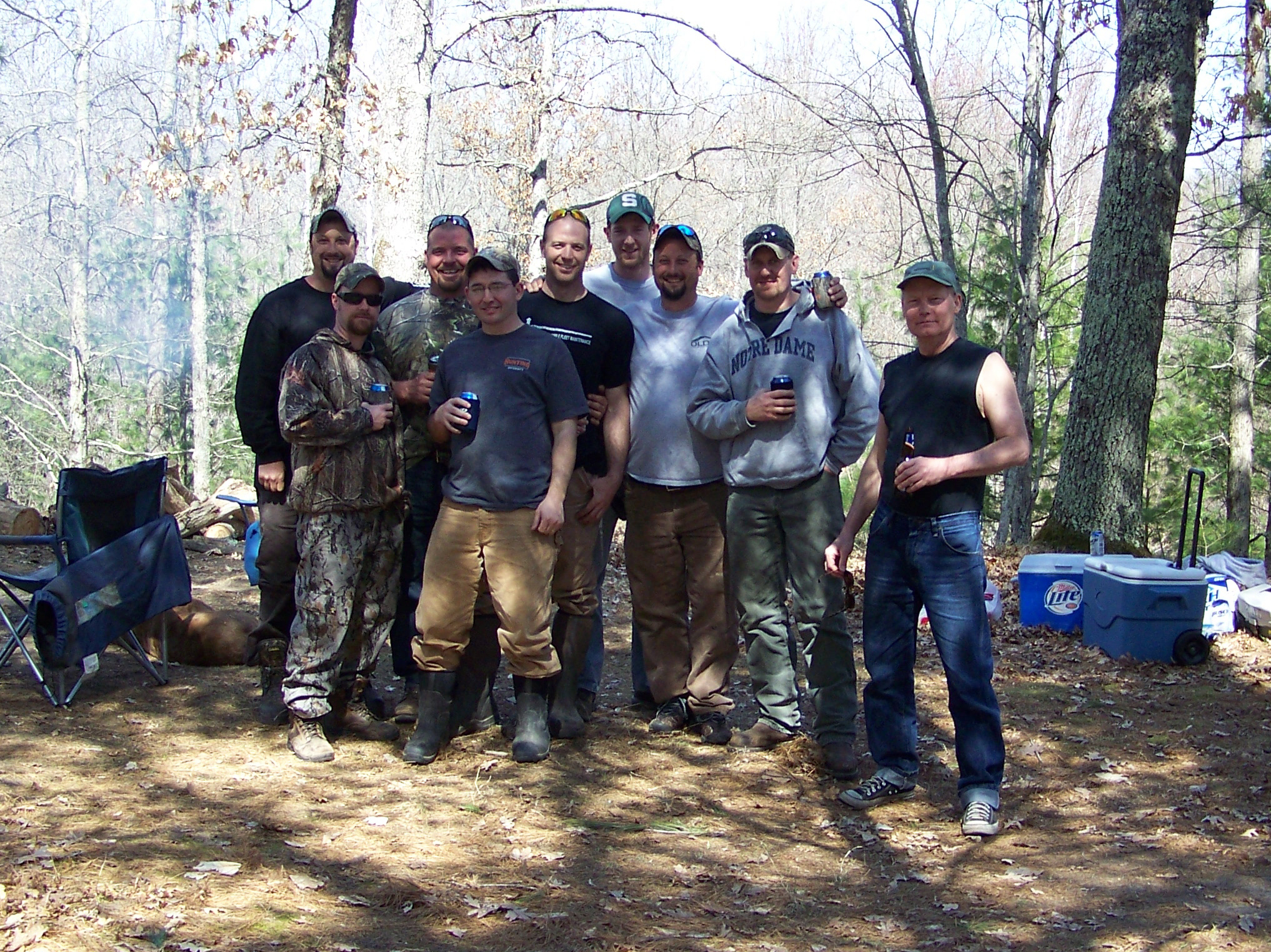
After a grueling stretch on the flooded Pine River Feral and I stopped at an upper stretch of the Baldwin we thought might be good for a couple fish. Main rivers were near flood stage so it made sense to hit smaller water. We were surprised to see a large group camping in what we thought was a secret spot which is funny now since the guys camping there said they camped there every spring. We probably wouldn’t have stopped to talk but they seemed friendly and waved so we pulled in, cracked a beer and joined them. We asked about fishing and no, they really weren’t fishing but once caught a trout down the hill from camp. “Are you morel mushroom hunting?” No, not out for mushrooms. Some of the guys had camouflage so we asked if they were turkey hunters. No, they weren’t hunting. Bottom line: a bunch of guys that had to get outside and camp for a few days after a long winter. I could relate.

They immediately warmed up to Feral who threw out a couple zingers, including one about one of the guy’s wives. I was thinking about an escape route but Feral’s sense of humor sent out the right message. We asked if they had a name for their group and sure enough, they call themselves the DFA Hunt Club which brought a new round of humor as it stands for “Death From Above” which Feral suggested may involve members falling out of trees, and the conversation degenerated from there to other possible words that DFA might stand for.  They all had a sense of humor – which was great.

I asked if I could take a picture and post it on Fichigan – and they were good on that. Feral’s on the right in the photo above so, unofficially, he is their newest “non-dues” paying member. I should mention theses guys are serious bow hunters that promote the sport including teaching the next gen of young hunters about sportsmanship and safety. They have a logo they put on t-shirts (see photo below) so if you run into one of them say hello and mention you saw them on a fichigan post.

DFA Hunt Club logo

Rods and Reels

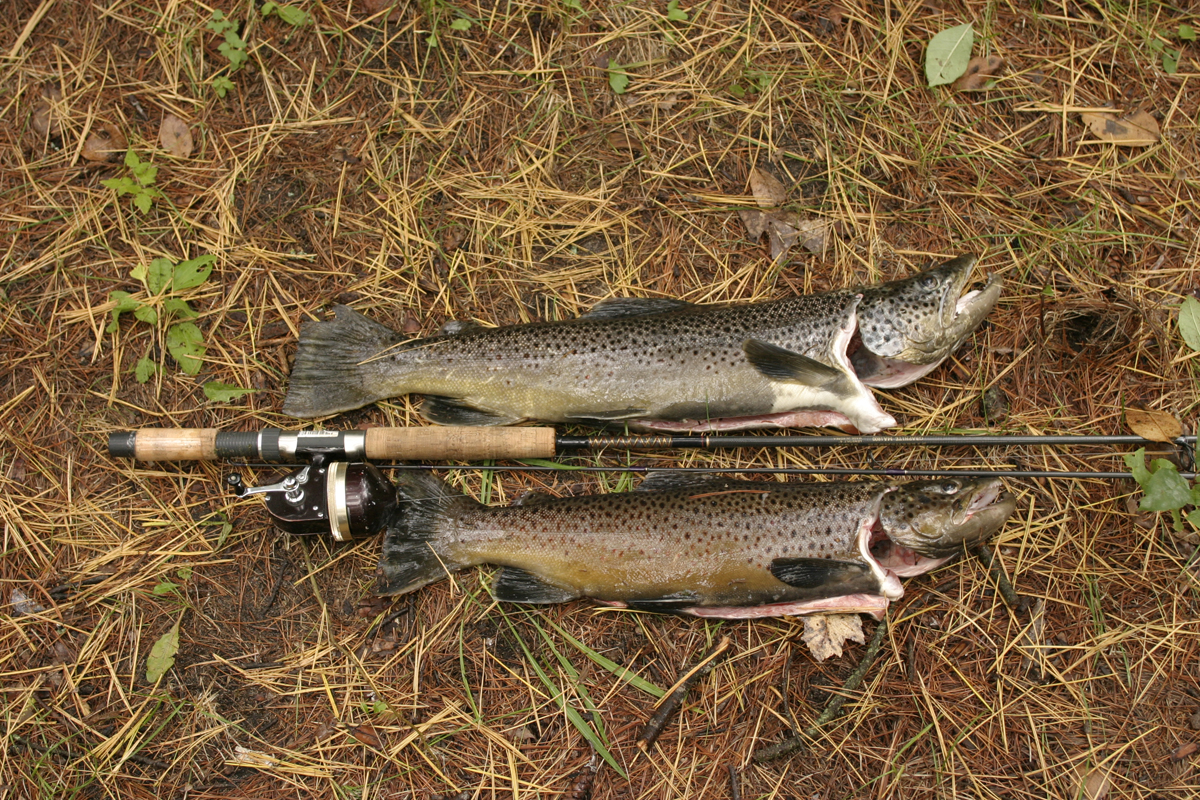
Shakespeare 1776 reel and hook jawed brown trout

Aside from the hook-jawed male brown trout in the above photo you might notice the rare left hand Shakespeare 1761 reel, circa 1960s. It belongs to Denny, one of our trout camp regulars. He has three of them which he manages to keep working, somehow. He doesn’t care to fish with anything else and I can relate, even though I have ventured to the dark side. Compared to the spin cast reels on the market today, the old Shakespeare’s feel like precision machines. No high tech alloys or injected plastic, just well machined pieces that fit together in a surprising bit of functional engineering. There is nothing on the market like it today, and even Shakespeare couldn’t get it right when they introduced the 1810II, a remake of their most famous closed face spinning reel from the 60’s.

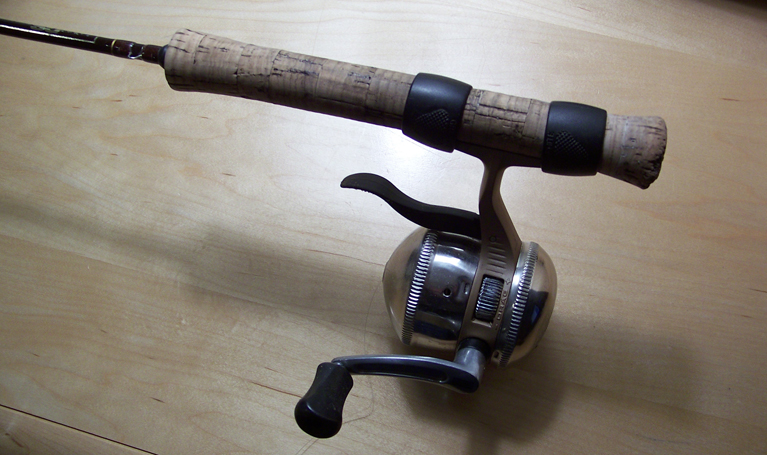
When asked to recommend a spinning rig for small streams my answer is: I can’t. I have tried every brand of closed face spinning reel on the market and no one is producing anything that really works well consistently. I can’t depend on new spin cast reels lasting more than a season. Handles fall off. Pick-up guides stop working. Gears grind when there doesn’t seem to be a reason. I have tried the various “underspin” designs including those by Shakespeare, Pflueger, Diawa, and Zebco. For what it is worth I think the Zebcos are the most reliable maybe because they have a long history of spin cast reels going back to pushbuttons. Last year I used a 33 Gold Triggerspin and can say this: I caught a lot of big trout with it. I had to change line often because the tiny pickup pins wreak havoc on monofilament, but the reel was mostly trouble free.

This might be a good time to mention my total dislike of open faced spinning reels – the kind with the revolving bail and open spool. For the type of casting I and my buddies do – it is just not an option. It goes to the type of casting we do – we pinch the line against the rod handle, release the bail, cast, and stop the lure in midair just above where we want the lure to land. The small hole in the cover of the close-faced reels allows us to catch and pinch the line against the rod handle to stop the lure in flight. With open spools – the line is not available to pinch because it flies off the circumference of the spool.

I have a pretty good and inexpensive spinning rod that I bought at Gander Mountain, model GS Advantage IM6.  It’s light weight, stout enough to hook trout, and nimble enough to use an underhand flip cast to rocket lures across the stream into nooks and overhangs – places where trout like those pictured above like to hide. It has a cork hand with sliding rings that allows placement of the reel at the back of the rod where it belongs (for balance). See below.

Zebco reel and GS rod

So you can see I am not a purist and have visited the dark side. Tucked away in boxes somewhere I have a couple old closed-faced Shakespeare reels, similar to Denny’s 1761, I am saving for who knows what reason. One belonged to my grandfather, Jake Lucas, and I am afraid his ghost will come back and haunt me if I don’t take the same meticulous care of it that he did. He treated his equipment well – cleaning and oiling the reels often, placing them in a sock in an old cardboard beer case in the trunk of his 65 Chevy Impala. His rods were stored in hard cases. He would assemble what he needed/wanted when he parked at a stream side. He treated his fishing equipment like an old machinist treats his precision tools – with love and care. I should probably treat my $25 Zebco the same way but in the back of my mind I know it will wear out quickly no matter how many times I oil it up.

I should attribute the fish in the top photo –  Mike, another trout camp regular, caught the larger brown and Denny the other nice one. Last time I fished with Mike he was using one of the defunct Shakespeare 1810II reels and a long rod I might consider for steelhead, though it obviously works well for stream browns.

Steampunk Trout Camp

HG with polaroids on way to the Pigeon River

HG with polaroid helmet on way to the Pigeon River

When HG showed up in his time machine looking for some flyweight Hodgman waders Feral Tweed pulled him aside to show him one of his own inventions, the blowgun firearm. The well travelled HG admitted he had never seen one before so Feral loaded up a retro muzzle-loading model and HG proceeded to blow a squirrel off a tall oak whereby Feral cleaned the rodent and put it in the stew pot with a mess of fresh vegetables and some unlabelled ingredients. HG asked about the ingredients but the conversation went silent. Feral buried the stewpot on a bed of coals and told HG to stick around if he’d like to go fishing.

Feral demonstrates a (patent pending) blowgun firearm

Feral demonstrates a (patent pending) blowgun firearm

HG saw my Shakespeare 1810 reel and Wonderod, circa 1960s, and asked if he could look at it and I said that would be alright but before I knew it he pulled out a tiny screwdriver and had the side cover off the 1810 and was pulling out wrenches for a complete dismantle. I had to wrestle the darn thing away from him. That’s the way it is with these gadget guys. Where was he when the drive belt went out on my Whirlpool washer? You can’t scold a genius so I told him to check out my 61 Apache Chief camper with the aircraft aluminum box and foldaway pole system.  “Look, don’t touch,” I admonished. He liked the camper and I could see the gears turning in his mind when he looked over at his time machine. A fold-out cotton duck canvas cabin tent on the aft end would make a nice addition.

By now it was late afternoon and Feral had an extra set of waders so we headed over to a remote spot on the Pigeon River that has some sandy patches and dark bends that give up some monster brown trout. HG is a little guy so Feral’s old Simms waders came up to his neck which was funny, the more so because HG had on a retro pot helmet with wrap around goggles that fortunately were Polaroid’s since most of that stretch of river requires walking into the sun at nightfall.

HG was a quick study. Feral showed him the Jake Lucas underhand flip cast and after casting straight up the first couple times he managed to bullet a #3 Blue Fox spinner at a grassy bank and was rewarded with sixteen inch brook trout which amazed both Feral and I since neither us had caught a brookie on the Pigeon since the dam went out at the Song of the Morning yoga ranch. We caught several more trout including a brown trout longer than HG’s forearm and after that we hustled out of there because we didn’t want HG to disappear down a beaver hole on the hazardous trek out. I said as much – and HG laughed saying that was how Jules Verne got the idea for Journey to the Center of the Earth. “Such a Klutz,” he intimated.

Around the campfire, shoveling down squirrel stew with a cold Labatts, HG said he hadn’t had so much fun fishing since the time he and Hemingway knocked down a bottle of bourbon and took a rowboat out on the gulf. The sharks got their tuna but that’s another story.

Spring Steelhead in Small Streams

Mike with Steelhead

Mike scores a Steelhead on the Baldwin

Michigan has an early opener for spring steelhead and depending on how you look at it – it is either the most fun you can have or a good way to destroy your Chinese made fishing reels. Spring steelhead can run upwards of 25 pounds and aren’t shy about hitting lures. It is a science and passion for a lot of anglers. Depending on weather and stream conditions the spring steelhead spawning runs can overlap the opening of the general trout season so you might find yourself casting for a keeper Brown and think you snagged a beaver.

I remember the first time I saw Steelhead in a stream, on the Little Manistee back in the seventies, and it was spooky looking down and seeing these huge fish cruising right next to your legs. There is a momentary panic where you wonder if you are on their menu.

Mike and Denny, if they don’t head up to Pigeon River country for the general opener, will usually check the Baldwin for Steelhead. If they are there, they are game. I should point out that they don’t test their Zebco underspin reels against the big fish, but rather use Shakespeare 1810 reels (circa 1960’s) and stout seven foot rods, equipment more geared to hold and keep bruiser fish out of the log jams. As far as I know they toss lures, not spawn bags, the most popular bait.

The Baldwin River, north and east of the town of Baldwin, is a great brown trout stream in the summer. South of town it empties into the Pere Marquette River which is on everyone’s list as a great steelhead and salmon river. So the big fish take a left turn at the Baldwin and find themselves in some pretty small water comparatively – think 15 foot wide and a foot deep most of the year.  Lots of gravel and lots of tight cover. So hooking a steelhead and landing it on the Baldwin are two separate things.

According to Denny, and this sounds familiar, every year one of them catches all the fish and they go back and forth. The above photo, taken by Denny, is from May of 2010 – so that must be a Mike year, and he’s holding one that may go 12 pounds (best guess) which he may weigh in on if he reads this post.  I wish I could say steelhead was a priority for me, but I’ll trade them all for a twenty inch brown.

Fishing Flooded Rivers

Natch on the flooded Pine River, early spring.

Natch on the flooded Pine River, early spring.

I can’t count the number of times I drove up to the Pine River only to find it so flooded that it was impossible to fish. But here’s the thing – I had to try. When a rain starts the trout slam the buffet and that means any lure tossed into the water. It can last for a day, but if it’s a downpour then it can be a matter of hours before the river is carrying so much mud it seems like Nestles has a chocolate milk factory upstream. When the stream muddies up – the fish are still active but they are at the bottom of the stream and your lure is coasting past them like it’s in an alternate reality.

Stepping into a muddy, flooded river qualifies as entering an alternate reality. You can count on the stream being twice as deep as you expect, plus six inches. If you survive getting in, triangulate your position before taking a further step so when you trip over the submerged bottom log you will have some idea of where you might get back out.  Experienced anglers have a special way to enter flooded rivers that reminds me of a scene from Romancing the Stone and a long muddy slide, though the chances of landing on Kathleen Turner seems pretty remote.

Back to the River. OK, you made it in, now what? Since it is almost impossible for the trout to see your lure, your best bet is to upsize. If you normally throw a two hook minnow bait, grab a #13 three-treble silver or gold minnow. Casting will not be pretty. Lob the lure like it has cooties and try to pinch the line before it reaches its destination.  This will straighten out the lure before it enters the stream which is the best advice in this entire post.  If a three hook lure enters the water at an odd angle, it will most likely catch the fishing line and retrieve sideways or backwards, which doesn’t catch a lot of trout.

Don’t have a #13 dredger? Try the biggest spinner in your tote. Ideally – fat blades with lots of flash. I like a gold color in muddy water, silver if the stream is more stained than muddy.  There is a good chance you will lose the lure but you need to weigh that against catching a big trout, which is very possible. The big fish are not timid if they think they are invisible. Here is a second good tip. Work the banks since the water is shallower at the edge. This bumps your chance of a trout seeing the lure. That said; cast everywhere because a stream bottom will have some shallow spots even mid-stream. Also, don’t be surprised if a trout takes your lure right at the rod tip. That’s when it gets fun.

Post Navigation