Fichigan

Small Stream Trout fishing in Michigan

Archive for the category “Trout Gear”

The Mepps Black Fury Spinner

I always carry a #3 Black Fury spinner with me when trout fishing. I don’t use the lure often even though I have a lot of faith in it. I’ve caught a lot of trout on this and smaller versions over the years. It was all I used on the Baldwin River when I first started spin fishing – it was that dependable.

Now I use it when I need something magical, something that makes no sense, something the trout won’t recognize but want to attack. The stream conditions and topography have to be right. I mainly use it for deep pools and runs. If the water is stained and the stream flooded, that is a bonus. The lure sinks out of sight, down where big trout hold in deep water, and can be reeled in slow because of the large blade. There is no second guessing when a trout hits it. They smash it. The single treble hook does its job – the trout stay on until landed.

Sinking out of site means you can lose the lure on hidden logs and branches. If you do get hung up, wade upstream of the snag as far as possible to leverage it off.

I also carry plain gold and silver spinners in various sizes which must look like the scales of small fish glittering in the stream. On bright days and clear streams, the glitter can entice trout out of cover even though the fish may be smallish.

Mepps also makes a version with a bucktail but I prefer no tail for trout.  For Pike fishing, I think a bucktails adds to the attraction. For trout I think the bucktail looks unnatural, though it is impossible to understand what they consider natural considering they attack Black Fury lures. I have no idea what this lure represents to them.
Closed-face Spinning Reels

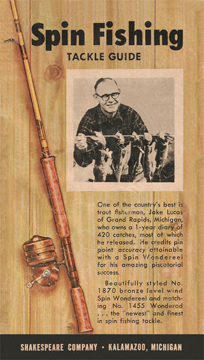
Back in the 1950’s and 60’s my grandfather, Jake Lucas, worked with the Shakespeare Company on closed faced spinning reel design, including the 1810 and other models. He was a bit of a legend – doing trick casting demonstrations at trade shows and on TV, with appearances on Michigan Outdoors hosted by Mort Neff. He would pop balloons out of the air and various other fun casting tricks.  He was quite a character, and a family man. He taught his kids and grandchildren how to do his underhand flip cast – and how to use it on a trout stream.  He pioneered a new way to catch trout using pinpoint casting while wading upstream, while the bulk of fisherman were fishing downstream tossing worms or trying their luck fly fishing.

He was extremely successful at trout fishing because he could place a tiny spinner underneath an overhanging branch across a stream in the most difficult places to reach. And set the lure down gently so as not to spook the trout. He did this with the help of the reels he designed with Shakespeare – closed face spinning reels, like the original model 1810, not to be confused with current reels using the 1810 designation. The original Shakespeare reels are collector’s items and purists are always on the lookout at garage sales and the internet.

Here is what makes the reels unique:

In order to cast the reel, the user backs up the handle a half a turn to release the bail. None of this is visible since the reel spool has a cover (hence close faced).  The reel body is placed very close to the handle of the rod, typically cork, so the user traps the line against the cork with an index finger before releasing the bail. This has several advantages – it is easy to release the line at the right millisecond when making the cast, and it is easy to stop the line with the index finger when the lure reaches the destination. You don’t cast the lure and let it plop in the water – that scares trout. You stop it mid air and inches above the water so it drops in without a splash. The reel was designed around this concept, though few anglers, even 1810 enthusiasts, understand the principals behind the design, or best use of the reels.

Jake was a pioneer in the sport of trout fishing and I occasionally run into people he knew and taught. He was generous with his time and instruction. They need only see me cast and to know where I learned. It’s always good for a conversation.

Waders 101

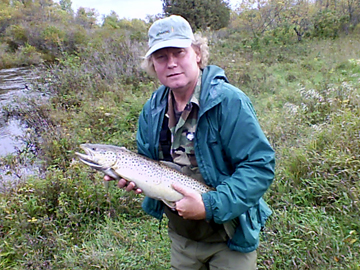
Feral Tweed with a good Brown Trout

If you are serious about small stream trout fishing you will need chest waders. Visit any large outdoor supply chain and you will find a large variety of waders you absolutely do not want to buy. And a few pair that make sense. For years I wore chest waders with a built-in boot. They were made of canvas, lasted a few years, and I could get in and out of then easily. On a scale of 10, they were about 5 for comfort and weight.  Now I wear superlight stocking foot waders with wading shoes and here is why: It’s like wearing a comfortable pair of pants. Trout fishing involves a lot of walking, a lot of grueling wading (upstream), and after that, more walking. Waders can sap your strength, make you sweat, and slow you down.

You can buy light weight waders and boots for not much more than conventional waders. My waders (Hodgeman Wadelites) and shoes ran about $100.00 on sale. See the “about” page to check out my waders. You can spend more, much more, and the investment may be worth it. Keep your receipt. My main fishing partner and trout legend, Feral Tweed, pictured above, purchased a pair of light weight Simms waders ($200+) that leaked right out of the box. This may have been the exception, as the Simms brand gets good reviews generally.

Do not worry about warmth, at least for the type of trout fishing I will be explaining in later posts. Do not buy rubber waders or waders that seem to promise you will stay warm, including neoprene. You will be on the move, even in cold spring or fall weather, and warmth is not an issue. If you think you will get cold, you can always put on a pair of long johns.

At some point, all waders leak.

Wader Repair: If your light-weight waders leak around a seam – pick up a tube of SEAMGRIP, turn the waders inside out and coat the seams. If you puncture them on a snag, waders typically have a repair kit including patches.

Post Navigation