Fichigan

Small Stream Trout fishing in Michigan

Archive for the category “Trout Advice”

If you teach a Girl to Fish

Someday they may bring you a fish and that would be great. Nothing like a fresh fish for the grill or skillet. I wish I would have spent more time fishing with my daughters but maybe the important thing is not the amount of time we spent fishing, but the fact that we did fish. Now, when they get the opportunity, it is not some foreign thing. There is fun to be had. My youngest daughter sent me this photo last summer when visiting her Uncle Bill. Her cousin Brent rented a charter on Lake Michigan and Lisa was game.
Lisa with Salmon

Lisa teaches outdoor biology and is our family’s world traveler including trips to exotic lands to catalog wild amphibians and reptiles. Handling fish? No problem.

I wish my oldest daughter had been there too – I would have loved another photo!  As kids the two of them were competitive about catching bluegills out of Big Star lake and I expect Sara would have been in the hunt right along with Lisa.

Feral has a daughter also whom he taught to fish – not just boat fishing but wading trout streams. Patti has stopped by at trout camp a couple times and once asked to fish with me. We went to a mosquito infested spot on the upper sturgeon that can be described as difficult to wade and cast but that did not slow her down – she took a nice trout out of a hard to cast pool. Wow.

Patti with Brown Trout

So here is the message: If you are a young man with daughters please share your outdoor experiences. Don’t stereotype your young daughters as too feminine to enjoys the things you enjoy. Someday they may bring you a fish, and memories to last a lifetime.

Bank Fishing for Brown Trout

Natch and Feral asking for advice

Natch and Feral hanging on my every word.

Bank fishing is a very enjoyable way to fish for trout because it combines sitting in a chair with the illusion of doing something productive. Maybe you can relate to that. Here are some tips to make the experience memorable and with a lot of luck, catch a trout.

You’ll need at least two buddies who are more serious about bank fishing than you because someone needs to catch a fish, otherwise what’s the point? Study the faces above and try to find guys that look different. Maybe that nerd from work. Or that guy that drinks Pepsi all day?

The important details: If possible, cut your forked stick before you head down to the stream because that will allow you to set up in the best spot while your buddies are cutting their sticks. The best spot will be the one that is upstream of the big pool so when you cast your line it drifts to the middle of the pool so your buddies have to get their lines out of the way. If your line does cross theirs, shake your head and make a face to let them know you’re not used to fishing with amateurs.

If you get a bite (rare) or hook a trout (more rare) deliberately move downstream so they have to get out of the way. Add some excitement by flailing the rod so they understand they could get an eye poked out. Then let the the trout zig zag the whole pool so your buddies are relegated to strictly watching. This is your moment – put on a show! Caution: This can backfire. If the trout is under ten inches try to release it discretely before they get a look.

Between bites most anglers like to lie about the huge trout they caught in the very same pool. Believability goes up in direct proportion to the amount of beer in the cooler so if you are prone to reminiscing make sure someone, preferably one of your buddies, bought the right brand of beer and ideally carried the cooler down to the stream by himself. Make sure you do a few jerky spasms and mention your bad back well ahead of time, ideally back at camp when it’s time to gather firewood. If it still falls on you to bring the beer – make sure it’s not twist tops and that you have the only opener. Someone needs to regulate consumption. It’s for their own good.

A comfortable chair is a must. If you have a leather recliner that will fit in the back of your pickup and will roll down the hill to the stream – that is ideal. (If you have a winch you can use to get it back up the hill – even better). Barring that, try to avoid those confounded collapsable camp chairs that sit crooked on level ground. You know the type. You have to be a yoga expert to get out of them.

Tackle: Don’t use your good stuff. The chance of getting hung up on a log on the bottom of the stream is 100%. Breaking the tip off your pricey Fenwick rod is a loss no angler can afford. Now’s the time to haul out the garage sale surf rod with wrought iron core. Something with backbone. Grab a reel with light line – chances are you’ll only catch tiny trout anyway and light line has some advantages that go right to strategy.

Stream Strategy: When you get hung up on a log pretend it is a lunker and break your line quickly. It’s the big one that got away and your status as a bank fisherman jumps ten points.

Respect for Other Anglers

Luther on Sturgeon

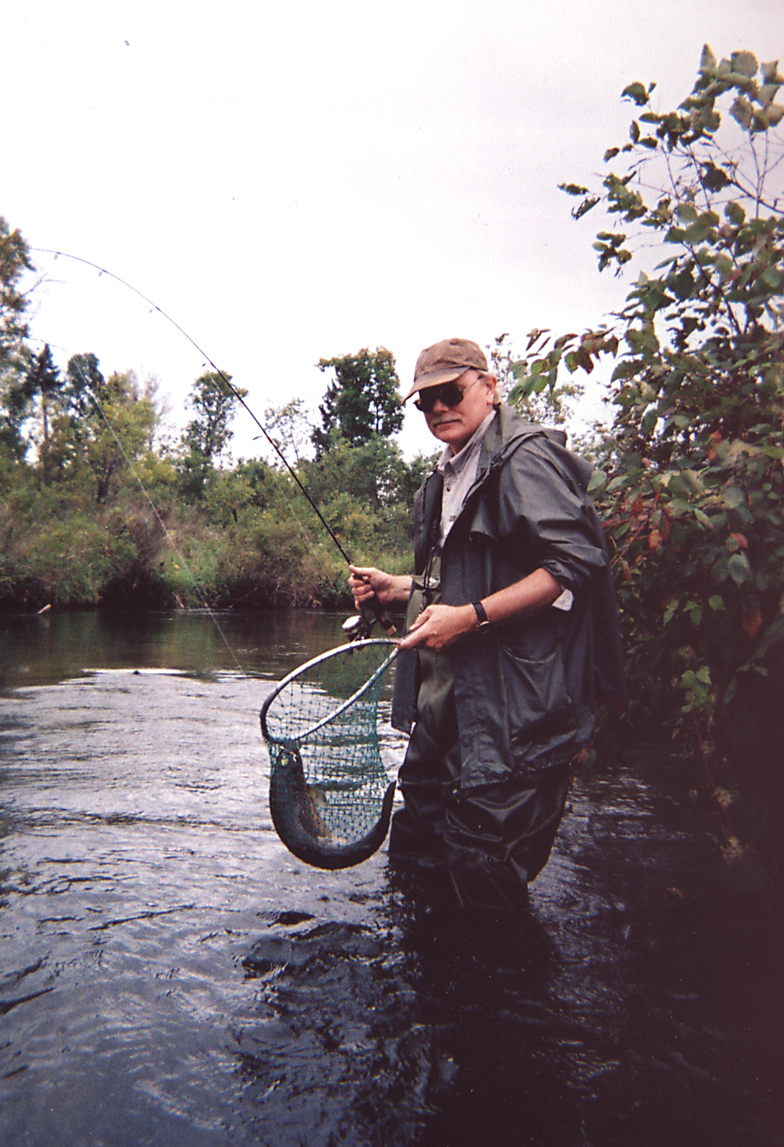
Feral and I did a long walk into a remote stretch of the Sturgeon River near Vanderbilt a couple years ago to a favorite spot that gives up some big fish. We hit it just right. The river was up and stained, the cool fall weather meant big browns were moving upstream to spawn and we had the river to ourself. We put in on a straight section that held some good cover and right off the bat Feral landed a nice fish. I moved into the lead and caught the fish in the above photo barely two minutes later. We hadn’t moved upstream 10 feet and already had two nice fish. We looked at each other and grinned. We were in for one heck of a trip.

Just then a couple fishermen appeared along the bank. They didn’t have waders. They saw the fish in the landing net and asked what lures we were using and we steered them in the right general direction figuring they would move on. The public water went for miles both directions. Instead they put on lures and started casting right in front of us. We spoke up and said we were fishing this stretch and would they mind finding a different stretch and they were indignant about it, like who did we think we were? They moved up another 30 yards and started casting again. I was angry but Feral brushed it off and figured why make a fuss – they are idiots or worse. Sometimes you run into people like that.

I hope it isn’t a symptom of a New Era. As kids, our Grandpa raised us to respect other fishermen on the river and that meant if you run into another angler you figure out what they are doing – then you adjust your plans around theirs. Don’t interrupt their fishing experience. They were there first, after all.

Later I tried to rationalize what happened. Maybe the two guys were part of the salmon crowd that fishes Michigan rivers. For that type of fishing anglers often stand right next to each other, elbowing each other out as it were, like it is part of a game. Which brings to mind a funny story.

Our Grandpa (Jake Lucas) tried every type of fishing including salmon. When salmon were first introduced to Michigan rivers he was in a crowd of anglers on the Betsy or maybe Bear Creek and an angler upstream had on a nice fish which broke his line. Jake could see the severed line floating down past him so he cast over it, snagged the line, then tied the end of the line to his pole. Then he fought and landed the fish. Meanwhile, the angler upstream was watching the event unfold. When he saw Jake land the fish he rushed downstream to his side and said, ” Man, I sure was lucky to get that one.”

Jake gave him the fish. I think he figured anyone desperate enough to make a logic leap like that needed the fish more than he did. I should take a lesson. Maybe those two guys on the Sturgeon needed a trout a lot more than we did. One thing for sure, their grandfather didn’t teach them to have respect for other anglers.

Pigeon River Brown Trout

Feral and I usually close out the trout season in the Pigeon River State Game Area mainly because there are two exceptional trout streams for brown trout, the Sturgeon and the Pigeon. We count on the weather turning nasty at the end of September but this year we had cold weather and low, clear streams. For big browns in the fall – it helps to have rivers at almost flood stage which triggers the spawn and movement of large brown trout into the upper stretches of the rivers. So we didn’t get our wish, but still caught a couple nice fish over twenty inches. Our cohort, Natch, upstaged us this year with a trip to the Sturgeon where he took even larger fish. No video, but a recount of his story with photos will be posted later on Fichigan.

The Zoppa Rig

Alvin, no relation to the chipmunk, provided a lot of entertainment at trout camp in the seventies but his influence on the world of fishing is only now becoming recognized. Maybe it was his supreme confidence about the sport in spite of his lack of the “latest greatest” equipment and lures that became must haves for lesser anglers. Alvin invented as he went along and I am convinced he would have been declared the winner of any Survivor show that included a place to fish. By winner, I don’t mean the guy that wins a million dollars, I mean the guy that makes the absolute best of where he is at, in effect, living off the land, in style. When the skinny survivors from suburbia get hauled back to the mainland, Al would decline the ride back and spend a few extra months enjoying the tropical paradise.

Luther and Al, late 70's

Luther and Al, late 70’s

As a fisherman, Al wrote new rules. His tackle box doubled as a tool box and carryall for odds and ends. When he opened it around other fishermen, there was a collective gasp as his peers tried to mind sort the congested mess of strange artifacts cobbled into a Rubik’s cube of pointy objects, rusted hooks, copper blades, smoking paraphernalia, and monofilament line bird’s nest. That’s where Al’s genius took over because in less time than it takes to read the bible Al would have a conglomeration of mostly fishing things half-hitched to the tackle end of a yard sale spinning rod he stopped to buy on the trip to camp.

There has been some speculation that the “Zoppa Rig” was invented strictly for Musky fishing on the Roger’s Dam reservoir, but now the word is out – The Zoppa rig can and has been used successfully for most every game fish in Michigan including all species of trout, catfish, bluegills, crappie, suckers and carp, as well as large and smallmouth bass. In the right hands (Al’s) the Zoppa Rig transcends species.  And that’s why it is so dangerous.

There are no known photographs of the Zoppa Rig but Feral Tweed did make a sketch based on memory. I concur on the accuracy but should point out that minnows or chicken intestines can be substituted for the two crawlers depicted in the sketch, though crawlers are the preferred generic for the widest assortment of game fish. Note also that the AC spark plug should have more rust and a silver key can be substituted for the gold key for rainbow trout.

Zoppa Rig

Al passed away several years ago but whenever Feral Tweed and I are hard pressed to figure out how to get a fish, when the fishing is shut down cold,  I will look over at Feral who will nod slowly and say “Yeah, it’s time for a Zoppa Rig.”

Rods and Reels

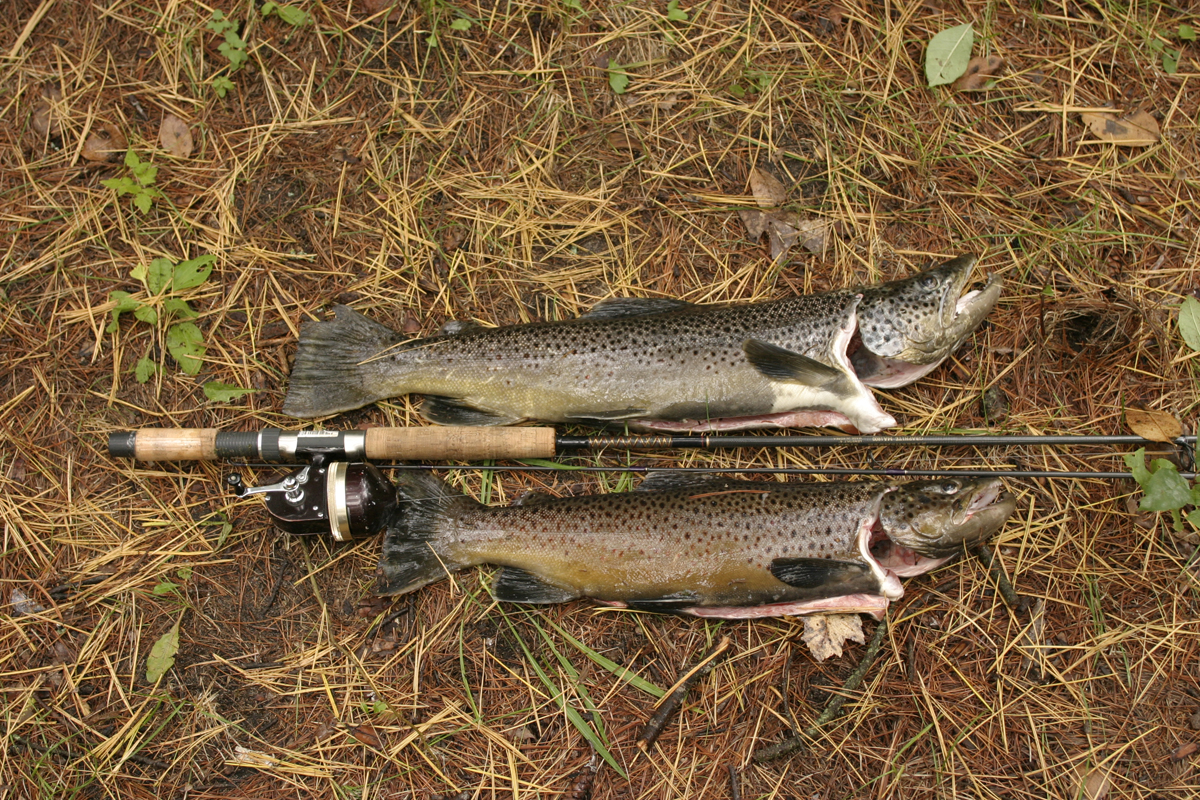
Shakespeare 1776 reel and hook jawed brown trout

Aside from the hook-jawed male brown trout in the above photo you might notice the rare left hand Shakespeare 1761 reel, circa 1960s. It belongs to Denny, one of our trout camp regulars. He has three of them which he manages to keep working, somehow. He doesn’t care to fish with anything else and I can relate, even though I have ventured to the dark side. Compared to the spin cast reels on the market today, the old Shakespeare’s feel like precision machines. No high tech alloys or injected plastic, just well machined pieces that fit together in a surprising bit of functional engineering. There is nothing on the market like it today, and even Shakespeare couldn’t get it right when they introduced the 1810II, a remake of their most famous closed face spinning reel from the 60’s.

When asked to recommend a spinning rig for small streams my answer is: I can’t. I have tried every brand of closed face spinning reel on the market and no one is producing anything that really works well consistently. I can’t depend on new spin cast reels lasting more than a season. Handles fall off. Pick-up guides stop working. Gears grind when there doesn’t seem to be a reason. I have tried the various “underspin” designs including those by Shakespeare, Pflueger, Diawa, and Zebco. For what it is worth I think the Zebcos are the most reliable maybe because they have a long history of spin cast reels going back to pushbuttons. Last year I used a 33 Gold Triggerspin and can say this: I caught a lot of big trout with it. I had to change line often because the tiny pickup pins wreak havoc on monofilament, but the reel was mostly trouble free.

This might be a good time to mention my total dislike of open faced spinning reels – the kind with the revolving bail and open spool. For the type of casting I and my buddies do – it is just not an option. It goes to the type of casting we do – we pinch the line against the rod handle, release the bail, cast, and stop the lure in midair just above where we want the lure to land. The small hole in the cover of the close-faced reels allows us to catch and pinch the line against the rod handle to stop the lure in flight. With open spools – the line is not available to pinch because it flies off the circumference of the spool.

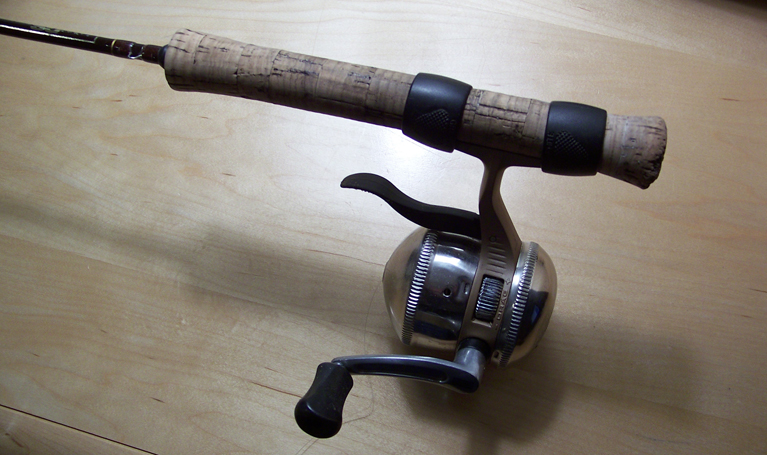
I have a pretty good and inexpensive spinning rod that I bought at Gander Mountain, model GS Advantage IM6.  It’s light weight, stout enough to hook trout, and nimble enough to use an underhand flip cast to rocket lures across the stream into nooks and overhangs – places where trout like those pictured above like to hide. It has a cork hand with sliding rings that allows placement of the reel at the back of the rod where it belongs (for balance). See below.
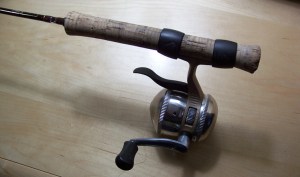
Zebco reel and GS rod

So you can see I am not a purist and have visited the dark side. Tucked away in boxes somewhere I have a couple old closed-faced Shakespeare reels, similar to Denny’s 1761, I am saving for who knows what reason. One belonged to my grandfather, Jake Lucas, and I am afraid his ghost will come back and haunt me if I don’t take the same meticulous care of it that he did. He treated his equipment well – cleaning and oiling the reels often, placing them in a sock in an old cardboard beer case in the trunk of his 65 Chevy Impala. His rods were stored in hard cases. He would assemble what he needed/wanted when he parked at a stream side. He treated his fishing equipment like an old machinist treats his precision tools – with love and care. I should probably treat my $25 Zebco the same way but in the back of my mind I know it will wear out quickly no matter how many times I oil it up.

I should attribute the fish in the top photo –  Mike, another trout camp regular, caught the larger brown and Denny the other nice one. Last time I fished with Mike he was using one of the defunct Shakespeare 1810II reels and a long rod I might consider for steelhead, though it obviously works well for stream browns.

Spring Steelhead in Small Streams

Mike with Steelhead

Mike scores a Steelhead on the Baldwin

Michigan has an early opener for spring steelhead and depending on how you look at it – it is either the most fun you can have or a good way to destroy your Chinese made fishing reels. Spring steelhead can run upwards of 25 pounds and aren’t shy about hitting lures. It is a science and passion for a lot of anglers. Depending on weather and stream conditions the spring steelhead spawning runs can overlap the opening of the general trout season so you might find yourself casting for a keeper Brown and think you snagged a beaver.

I remember the first time I saw Steelhead in a stream, on the Little Manistee back in the seventies, and it was spooky looking down and seeing these huge fish cruising right next to your legs. There is a momentary panic where you wonder if you are on their menu.

Mike and Denny, if they don’t head up to Pigeon River country for the general opener, will usually check the Baldwin for Steelhead. If they are there, they are game. I should point out that they don’t test their Zebco underspin reels against the big fish, but rather use Shakespeare 1810 reels (circa 1960’s) and stout seven foot rods, equipment more geared to hold and keep bruiser fish out of the log jams. As far as I know they toss lures, not spawn bags, the most popular bait.

The Baldwin River, north and east of the town of Baldwin, is a great brown trout stream in the summer. South of town it empties into the Pere Marquette River which is on everyone’s list as a great steelhead and salmon river. So the big fish take a left turn at the Baldwin and find themselves in some pretty small water comparatively – think 15 foot wide and a foot deep most of the year.  Lots of gravel and lots of tight cover. So hooking a steelhead and landing it on the Baldwin are two separate things.

According to Denny, and this sounds familiar, every year one of them catches all the fish and they go back and forth. The above photo, taken by Denny, is from May of 2010 – so that must be a Mike year, and he’s holding one that may go 12 pounds (best guess) which he may weigh in on if he reads this post.  I wish I could say steelhead was a priority for me, but I’ll trade them all for a twenty inch brown.

Fishing Flooded Rivers

Natch on the flooded Pine River, early spring.

Natch on the flooded Pine River, early spring.

I can’t count the number of times I drove up to the Pine River only to find it so flooded that it was impossible to fish. But here’s the thing – I had to try. When a rain starts the trout slam the buffet and that means any lure tossed into the water. It can last for a day, but if it’s a downpour then it can be a matter of hours before the river is carrying so much mud it seems like Nestles has a chocolate milk factory upstream. When the stream muddies up – the fish are still active but they are at the bottom of the stream and your lure is coasting past them like it’s in an alternate reality.

Stepping into a muddy, flooded river qualifies as entering an alternate reality. You can count on the stream being twice as deep as you expect, plus six inches. If you survive getting in, triangulate your position before taking a further step so when you trip over the submerged bottom log you will have some idea of where you might get back out.  Experienced anglers have a special way to enter flooded rivers that reminds me of a scene from Romancing the Stone and a long muddy slide, though the chances of landing on Kathleen Turner seems pretty remote.

Back to the River. OK, you made it in, now what? Since it is almost impossible for the trout to see your lure, your best bet is to upsize. If you normally throw a two hook minnow bait, grab a #13 three-treble silver or gold minnow. Casting will not be pretty. Lob the lure like it has cooties and try to pinch the line before it reaches its destination.  This will straighten out the lure before it enters the stream which is the best advice in this entire post.  If a three hook lure enters the water at an odd angle, it will most likely catch the fishing line and retrieve sideways or backwards, which doesn’t catch a lot of trout.

Don’t have a #13 dredger? Try the biggest spinner in your tote. Ideally – fat blades with lots of flash. I like a gold color in muddy water, silver if the stream is more stained than muddy.  There is a good chance you will lose the lure but you need to weigh that against catching a big trout, which is very possible. The big fish are not timid if they think they are invisible. Here is a second good tip. Work the banks since the water is shallower at the edge. This bumps your chance of a trout seeing the lure. That said; cast everywhere because a stream bottom will have some shallow spots even mid-stream. Also, don’t be surprised if a trout takes your lure right at the rod tip. That’s when it gets fun.

“The Loggy Stretch”

The owner of the party store/gas station in Vanderbilt asked Feral where he had been fishing on the Sturgeon and his answer was “The loggy stretch.” That was a fine example of thinking on your feet since the entire Sturgeon River in that county is log strewn. Another answer that may have worked was “the public water east of here.” The reason I am even thinking about this is I was watching a segment of Michigan Outdoors that featured some bird hunters and the host asked one of the three hunters where on earth they were. I don’t know if they blindfolded the host and camera crew on the way to their bird paradise but the hunter was clearly caught off guard. He mumbled something about not wanting to share that information. I could relate.

Feral and I have been fishing the closer up by Vanderbilt for the last dozen years and we have done our share of exploring in order to find some of the “less traffic” trout water. It helped that Mike and Denny, our most senior trout camp buddies, had a pretty good lay of the land before us so we were able to cull some information I’m sure they regret giving up. Those two have made a science of finding where to fish that includes a GPS, a Suburu Outback, and way too many bags of mixed nuts and cola. They are the Lewis and Clark of our outfit and I sometimes wonder if the exploring isn’t more fun to them than the actual fishing. Feral and I need to talk those two into an exploration of the Upper Peninsula which I understand is undeveloped.

But here is the point of this untimely post: How can you appear to share a secret location without giving away the garage? For some guys like Feral it comes natural but the rest of us need a process. So here we go.

  1. Keep a straight face.
  2. Refer to a landmark that may have nothing to do with the location
  3.  Nod your head like you have just given up the garage.

Conversely, if you can think on your feet like Feral, pick an environment generality and act like you’ve answered the question.

Same Lure / Less Trout

I remember a few years back fishing with Feral on the Pine and watching him catch trout after trout. I tried a variety of lures including what he was tossing but caught zip. If you were to follow either of us up a trout stream there would be very little to tell us apart. We use the same underhand flip cast to get lures next to the banks and under low hanging brush. We likely follow the same path up the stream – crossing the stream in the same places, making generally the same casts. We move about the same speed – meaning we take a similar amount of time on a bend or piece of cover before deciding to move on. We both wade quietly. We toss the same lures including a variety of minnow baits from various manufacturers as well as spinners and what not. So when one of us catches a lot of fish and the other is relegated to watch – there must be something going on.

Our roles were reversed at our fall trout camp this year. ( see 2012 Trout Camp Closer for more photos) Feral and I decided to fish a remote spot on the Pigeon we call bear country because of the difficult walk in through tangled blow downs, bogs, beaver slashings, and eye level branches designed to remove your hat or smack the guy  following. Thick stuff where you can imagine a bear rising up to say hello with a loud grunt after you step on his toe. I fished this spot alone occasionally but its nice having some company during the walk in since the conversation is two-sided and there is always the chance of running into another fisherman who may not be talking to himself.

When we reached the stream Feral let me take the lead on a wide slow bend with a grassy undercut bank.  I made two casts and watched a V- wake come back with the lure. He took it hard and I was on to a twenty incher which put up a good battle. Feral was kind enough to de-hook and release the brown trout and that set the stage for the morning.  He moved into the lead and right off a similar size fish followed his lure back but didn’t strike. He didn’t rest the fish at all, which surprised me, but continued casting and moving upstream. We each caught some smaller fish and pretty soon we came to a familiar bend which I almost didn’t recognize.

We carefully waded along the shallow outside of the bend. The inside had the faster water, a deep trough, and buried log cover and frankly it didn’t look so great mainly because the sun was up and the stream was clear. There was a little cut-in at the inside bank and I watched Feral work it with no result. I was close behind him and made almost the same cast thirty seconds later and was rewarded with a second twenty inch brown. Feral watched me make the cast, saw the lure, and saw the trout take it. If that were the first time it happened on this trip he would have shrugged it off as luck, but I had done the same thing the previous day on the Sturgeon – caught a twenty incher following behind him.

I offered to take the lead so he could catch some fish, which was funny at the time. Lesser men would complain but to Feral’s credit he asked: What are you doing different? And that must be it – I was doing something a little different because I was casting the same lure over the same water. I couldn’t explain it at the time but maybe it was the retrieve. By twitching the pole as I wound the lure back I imparted a more injured look to the minnow lure. I learned this trick bass fishing a top-water plug called a Pop-R which is the only way to fish that bait.  There’s a rhythm to it. I think Feral saw what I was doing and I don’t know if he emulated it, but at the top of the bend he caught a rainbow trout about twelve inches.

It was a beautiful fish but I know exactly how he felt because I sometimes think about that trip up the Pine where he was catching the eighteen to twenty inchers and I was lucky to catch a small keeper. Fortunately for Feral, he’ll always be able to remember this trip up the Pigeon since his fishing buddy has a blog.

Post Navigation